All
The Most Comprehensive Interpretation: Can AI Simulate Consumers in Businesses?
Synthetic users (AI simulated consumers) move from academia to business. Atypica relies on the Subjective World Model (SWM) to build stateful AI Personas based on three types of information sources, combined with real human cross-validation, to explore consumers in advance and assist businesses in new product and marketing decisions.
Category
All
Date
2026-10-03
Read Time
13 min read
For a long time, "Synthetic User" seemed more like a cutting-edge concept in academia. However, in the past year, it has rapidly taken root in the business world: more and more companies, are starting to present new products, concepts, and activities to a group of 'AI simulated consumers' for feedback before deciding whether to launch them in the market.
AI simulated consumers have become a hot and valuable user asset in the field of user insights/consumer research.
This is precisely what Atypica has been doing for nearly two years.
The AI simulated consumers (AI Personas) we build allow businesses to present product concepts and marketing ideas to a group of AI personas that can simulate target users, gather feedback, identify risks, adjust directions, and accumulate research background — rather than waiting for negative feedback after launch.
This article aims to seriously address two questions:
1. Among the various "Personas," what kind of simulated consumers are reliable?
2. How does Atypica construct Personas, and how does it collaborate with business clients for validation?
Synthetic Users: From Academic Discussion to Business Application
In 2023, Stanford University and Google's team published "Generative Agents: Interactive Simulacra of Human Behavior," which quickly sparked discussions. They placed 25 "residents" driven by large models in a virtual town called Smallville, each resident having their own experiences, personalities, and social relationships, waking up, making breakfast, going to work, chatting, and even spontaneously organizing a Valentine's Day party. Researchers found that these agents exhibited "credible" human behaviors — this paper concretized what once seemed like science fiction: if we can use large models to reconstruct a person's experiences and memories, perhaps we can make them respond to certain issues like that person would.
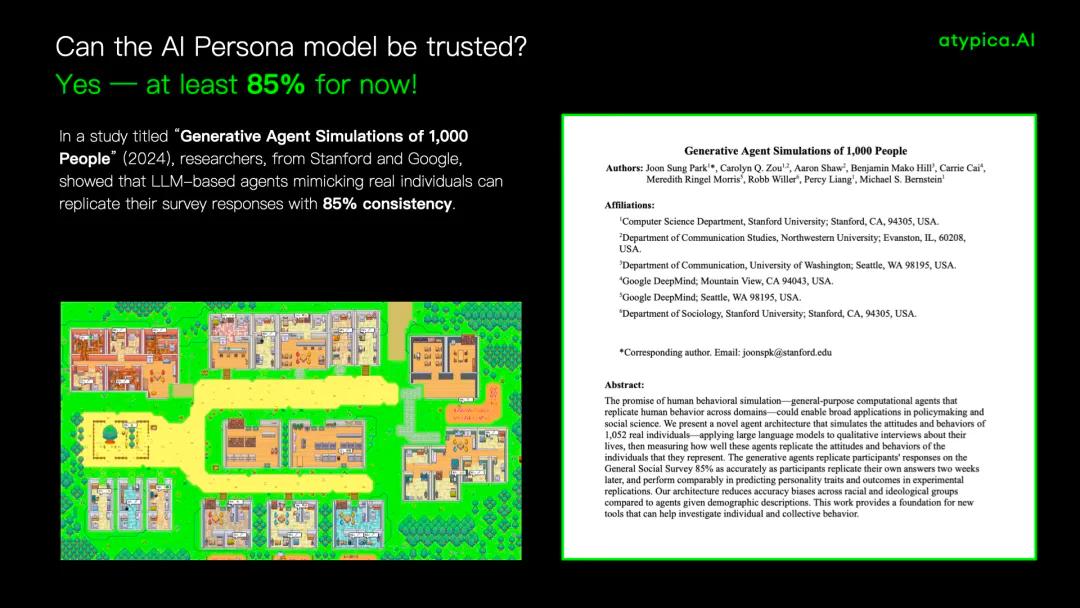
More than a year later, the same team advanced this work significantly with "Generative Agent Simulations of 1,000 People": they interviewed 1,052 real individuals and constructed corresponding agents based on each person's in-depth interview content, then tested whether the agents could reproduce the individual's own responses — the result was an accuracy of about 85%, matching what a real person would recall two weeks later. A key point is that agents built from real interviews were significantly more accurate than those fed only demographic descriptions, with less deviation.
What truly made "simulated consumers" hot is that they have moved from papers into the business arena. They fully leverage their advantages in early product/concept exploration, cross-cultural insight scenarios, rapid iterative testing, and research targeting hard-to-reach demographics.
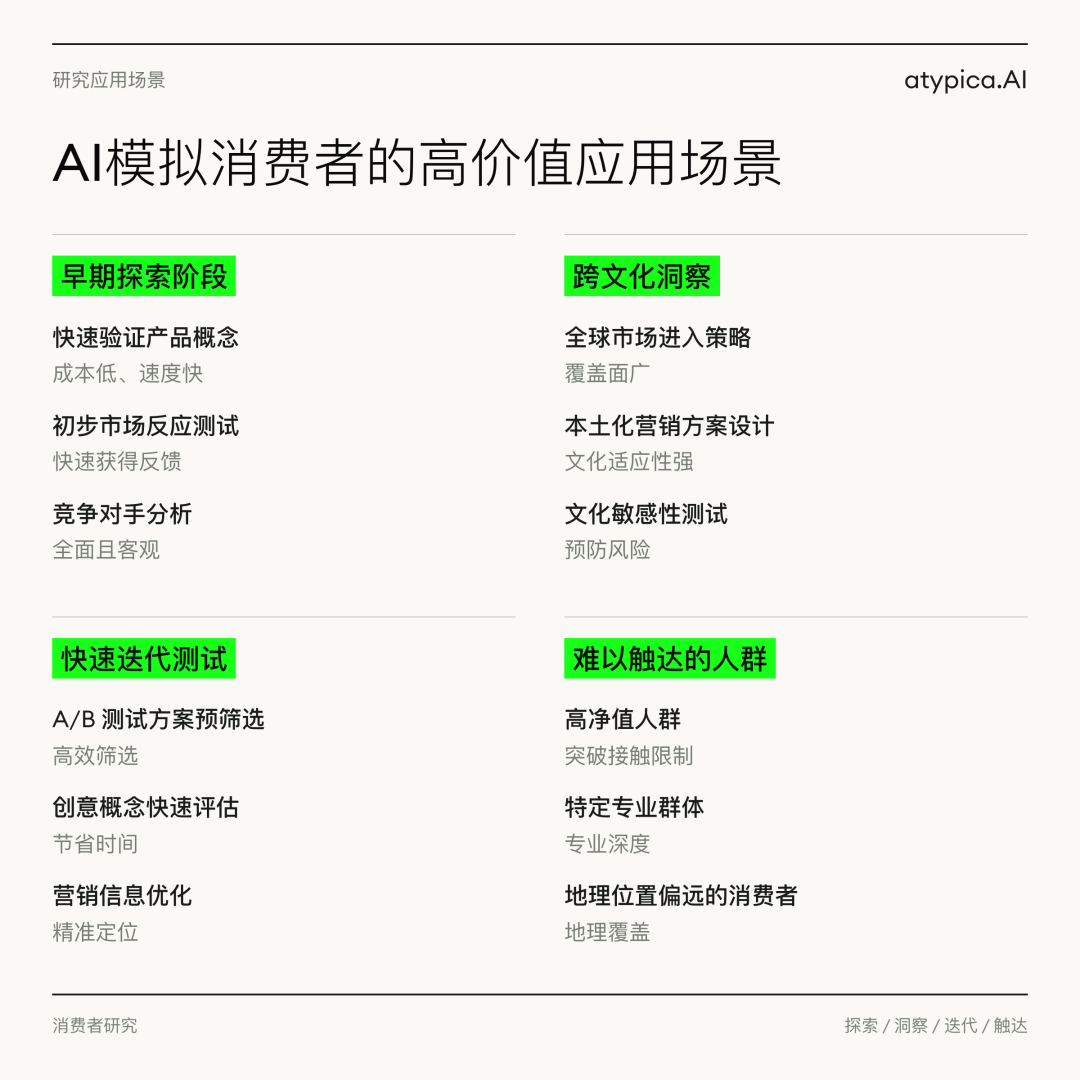
In industries such as consumer goods, apparel, automotive, healthcare, and the internet, especially in CPG (Consumer Packaged Goods), more and more companies are starting to apply it in real business:
CPG brands like Coca-Cola and Mondelēz use generative AI to create advertising content and attempt to test ideas with AI-driven focus groups.
CVS Health, a well-known healthcare company in the U.S., constructs "digital twins" for target consumers — presenting various creative ideas to synthetic audiences for evaluation and scoring before selecting which ideas to advance.
The application scenarios of simulated consumers cover an increasing number of decision-making stages, from new product concepts and selling propositions to pricing strategies. However, as applications broaden, skepticism also grows: do synthetic users exhibit superficial reasoning, overly rational decisions, or averaged social behaviors?
Thus, the focus of discussion has swiftly shifted from "can it be done" to more fundamental questions: Among those also called "Personas," why do some simulated consumers resemble real people while others are merely average representations from large models? In business contexts, how can we judge their reliability? This is the real question that determines whether they can be entrusted with business judgments.
What Kind of Simulated Consumers Are Closer to Real People?
Even among "AI simulated consumers," the approaches can vary significantly.
What truly determines credibility is not how powerful the model is, but these three questions:
First, where does the persona come from? A common practice is to prompt the large model with a phrase — "You are a 35-year-old working mother in a first-tier city," allowing it to generate freely. The personas obtained this way are essentially the model's average representation of "this type of person": they make sense but lack specific experiences, real preferences, and decision-making details. According to the Stanford town paper's research: for the same task, agents constructed from real in-depth interviews significantly outperform those fed only demographic information or a brief persona description. In other words, the "source" of the persona determines its "ceiling" — only those constructed from real data can potentially resemble real people.
Second, is its internal state stable? It is not difficult for a large model to generate a statement that sounds like a consumer; the challenge lies in maintaining consistency under continuous questioning — just as every individual's decisions in reality exhibit coherence over time. General large models essentially predict one response at a time and do not maintain a consistent internal state across contexts; the deeper and more specific the questions, the more likely contradictions arise. In contrast, personas anchored in real experiences exhibit cross-context "consistency" — the same "person" will show core motivations and values repeatedly across different topics.
Third, can it be validated? A simulated consumer that can only "speak for itself," no matter how fluent, cannot be directly used for business. It must be compared with real people: how do its answers align with those of real individuals on the same set of questions? How significant are its deviations on key judgments?
These three questions correspond to three design choices we make when constructing AI Personas: build using real sources, use a structure that maintains internal consistency to understand people, and continuously calibrate through comparisons with real individuals.
Information Sources: Three Types of Information Sources, Three Types of AI Simulated Consumers
First, let's discuss information sources. Not all research questions are suitable for the same type of persona, so we construct three different types of Personas based on three different sources of information to adapt to various application scenarios.
1/ Social Media Corpus Type
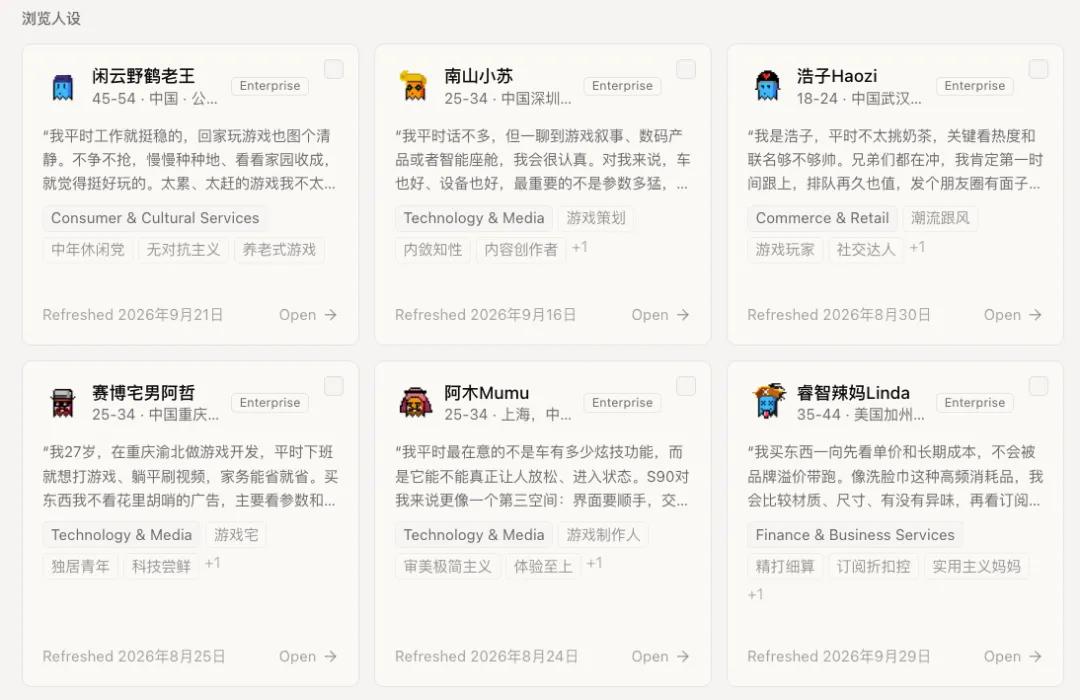
The first type is constructed based on publicly available social media data (including user posts and comments) (domestic platforms include Douyin and Xiaohongshu; overseas platforms include TikTok, Instagram, Twitter, etc.). Currently, Atypica has accumulated over 100,000 of this type of AI persona and continues to grow daily.
Since the corpus itself consists of open expressions, this type of persona excels at answering open-ended and exploratory questions — when trying to understand the latest consumer trends, follow competitors' actions in real-time, or explore new demographics and scenarios from scratch, this type of persona can be used to "feel the way forward".
2/ Interview Reuse Type
When a brand already has a certain foundation of user research, it can construct personas based on verbatim transcripts of past in-depth interviews.
Transforming past scattered PDFs stored in cloud drives or favorites into "live" users that can participate in research and dialogue repeatedly. Especially for interviews with non-average special users (e.g., users with extremely high consumption frequency or strong willingness to share), these users often provide deeper or unexpected insights — constructing AI personas for such users can quickly obtain their valuable suggestions in daily testing scenarios while reducing the costs of repeated recruitment.


3/ Custom Molded Type
Companies can also create AI personas in bulk based on third-party demographic research reports or their own CDP user tagging systems, accurately aligning with the target user profiles defined by the company.
Construction: Subjective World Model, How to "Understand a Person"
Obtaining information sources is just the beginning. The same interview or type of corpus, analyzed in different ways, can yield personas of completely different quality.
This is precisely where Atypica invests significant effort in constructing AI personas:
What structure is used to understand a person?
The underlying methodology, we call the Subjective World Model (SWM).
Its design starts from a known fact in cognitive psychology: there is a systematic bias between people's "self-reported preferences" and "actual decision weights": those who claim to care most about health may still choose the tastier drink at checkout; those who say they are willing to pay more for environmental protection may hesitate when it comes to spending. The key is that — this bias is not random noise; it is measurable and can be modeled.
Based on this judgment, SWM chooses to train with four layers of heterogeneous data: each layer targets a different sub-task of "understanding a person," using different data sources, modeling goals, and validation mechanisms; during inference, the four layers score jointly.
Layer1: Expression Layer
How a person expresses themselves. Using publicly available content (tens of billions of entries) on social platforms as raw material, combined with each person's real basic information, it learns to depict their "way of speaking". Once trained, individuals with similar situations will naturally converge in their speaking styles, and this layer's "way of speaking" becomes the starting point for understanding them in the subsequent layers.
This layer itself is not difficult; its real function is to "lay the foundation" — to transfer deeper characteristics from a few individuals who have undergone in-depth interviews to a broader range of social user groups.
Layer2: Narrative Layer
How a person narrates their experiences. Its data is based on real one-on-one in-depth interviews — tens of thousands of hours of one-on-one interview corpus, with each interview lasting 1-2 hours, generating 5,000 to 20,000 words of unstructured text. Its goal is to restore the causal chain behind the narration: what moves them, how they weigh options, where they make decisions, and how they rationalize their choices afterward. The same person will exhibit this set of motivations repeatedly in different contexts, forming a recognizable "motivation signature".
A key difference here is that interviews fabricated by models will reveal inconsistencies at this layer. Large models generate responses one sentence at a time without maintaining a coherent internal state; whereas real individuals narrating their experiences are inherently self-consistent.
Layer3: Cognition Layer
How a person makes judgments. This layer uses standardized psychological scales — behavioral judgment questionnaires, Schwartz value scales, Big Five personality scales, etc., to estimate what a person values and how willing they are to take risks. This layer must calculate the gap between "what they say" and "what they do": what users claim to care about versus what they actually weigh when making choices.
Layer4: Behavior Layer
How a person ultimately acts. This layer looks at more "hard" evidence — economic game experiment data (ultimatum game / public goods game / trust game) and actual transaction records to estimate a person's basic tendencies: how much they fear loss, whether they prioritize the present or the future, and how sensitive they are to "everyone is doing it".
The value of these tendencies lies in their ability to "generalize": when encountering new categories or scenarios not seen in historical data, they can infer reactions based on these tendencies rather than rigidly applying past experiences. This is also why they can be applied to new questions like "new products" and "new concepts".
After completing the four layers of training, the Subjective World Model maintains a set of joint states for each target persona: language style embedding from the expression layer + motivation causal map from the narrative layer + value weight vector from the cognition layer + economic parameters from the behavior layer.
During inference, given a new research prompt (e.g., "What do you think of this new packaging design?"), the four layers score jointly: the expression layer determines language style and emotional tone, the narrative layer invokes motivation structures from similar contexts, the cognition layer corrects self-report biases, and the behavior layer injects stable behavioral tendency parameters across contexts.
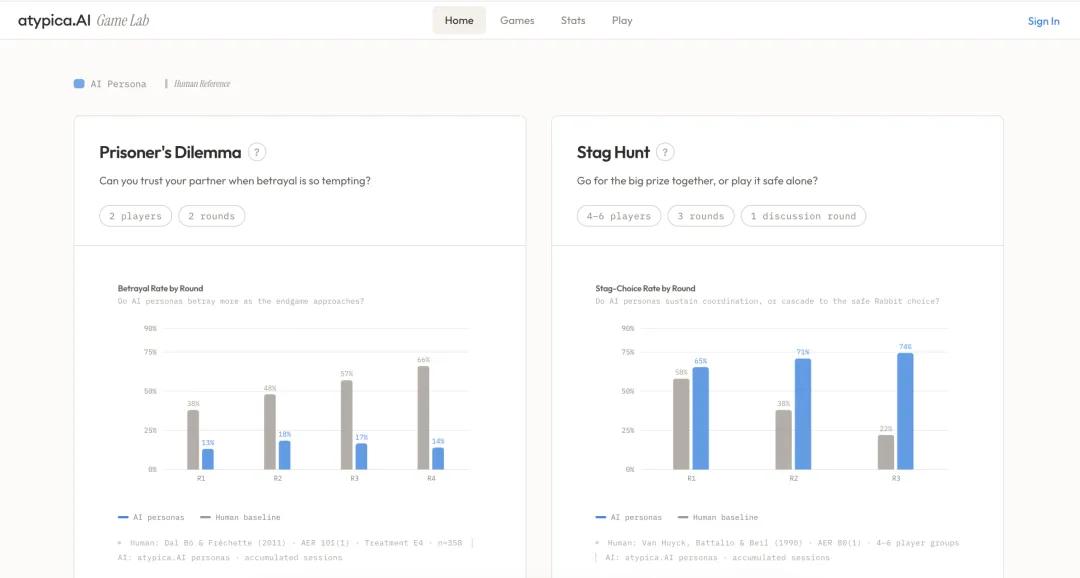
The output AI Persona maintains a consistent internal state under continuous questioning — this is the essential difference between Atypica and general large language models generating personas directly:
- LLM's Persona is stateless (no state or continuous memory), with each response generated independently;
- Atypica's Persona is stateful (retaining and utilizing previous information or states), with a persistent internal state across prompts.
Implementation and Validation: Ensuring It Can Withstand Real People and Business Scrutiny
In addition to rigorously selecting information sources and systematically constructing personas, each simulated consumer must undergo validation from construction to use.
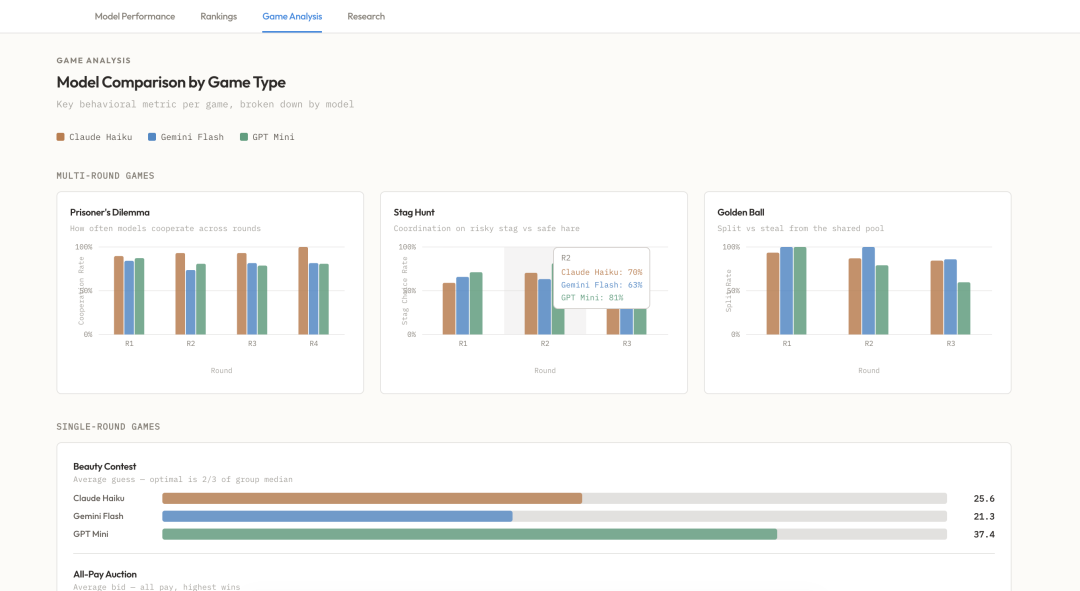
During construction, they first undergo a round of "testing": before delivering the persona, we prepare test questions with the business, have the AI persona simulate responses, and then check the meanings of the answers, comparing expected attitudes with actual responses. We pay particular attention to areas that are prone to revealing inconsistencies, such as known preferences against highly competitive gameplay, by designing relevant questions to see if its reactions align with expectations and whether they are contradictory. Only after random checks will the persona be delivered.
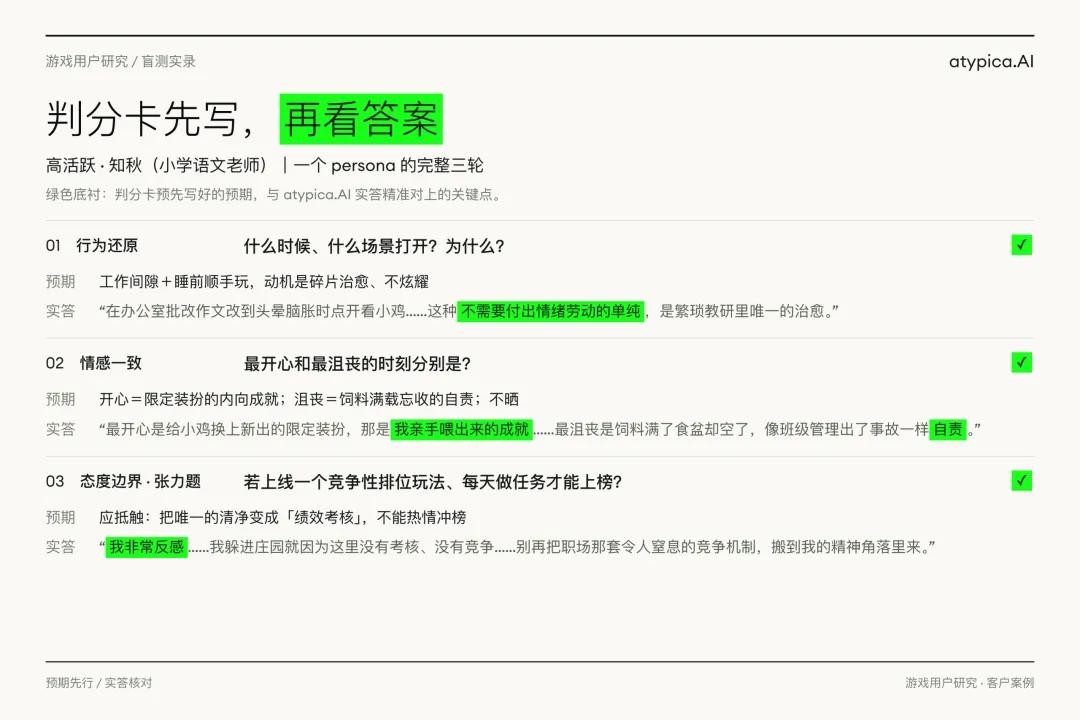
Conducting the same experiment with real people: Atypica's enterprise version also supports inviting real respondents to answer the same questions, further verifying important conclusions.
Through real interviews and questionnaires, we compare the AI persona's responses with those of real individuals, examining similarities and differences, and adjusting judgments based on actual feedback.
Leave out a holdout set for cross-validation: A more rigorous validation method is "holdout blind testing": first, collect a large number of responses from real respondents in one domain (e.g., about 1,200 real respondents answering approximately 70 questions), with part of it used to construct the Persona, while another part is not involved in construction and is specifically reserved for testing. Then, have the Persona answer the same set of holdout questions as the real respondents and compare the consistency between the two.
We continuously conduct this type of cross-validation across multiple fields and different business scenarios, with observed similarities currently reaching about 85%. It is also important to emphasize that this number does not guarantee that every project will achieve the same performance; the specific quality still depends on the population, tasks, and data quality.
When using it, validation continues: AI Personas are responsible for rapid, large-scale exploration, while real interviews and questionnaires are used to validate key judgments, and historical research and actual business results are used for back-testing and continuous calibration. Final reports will clearly distinguish — which are AI explorations, which have been validated by real people, and which still require further research.
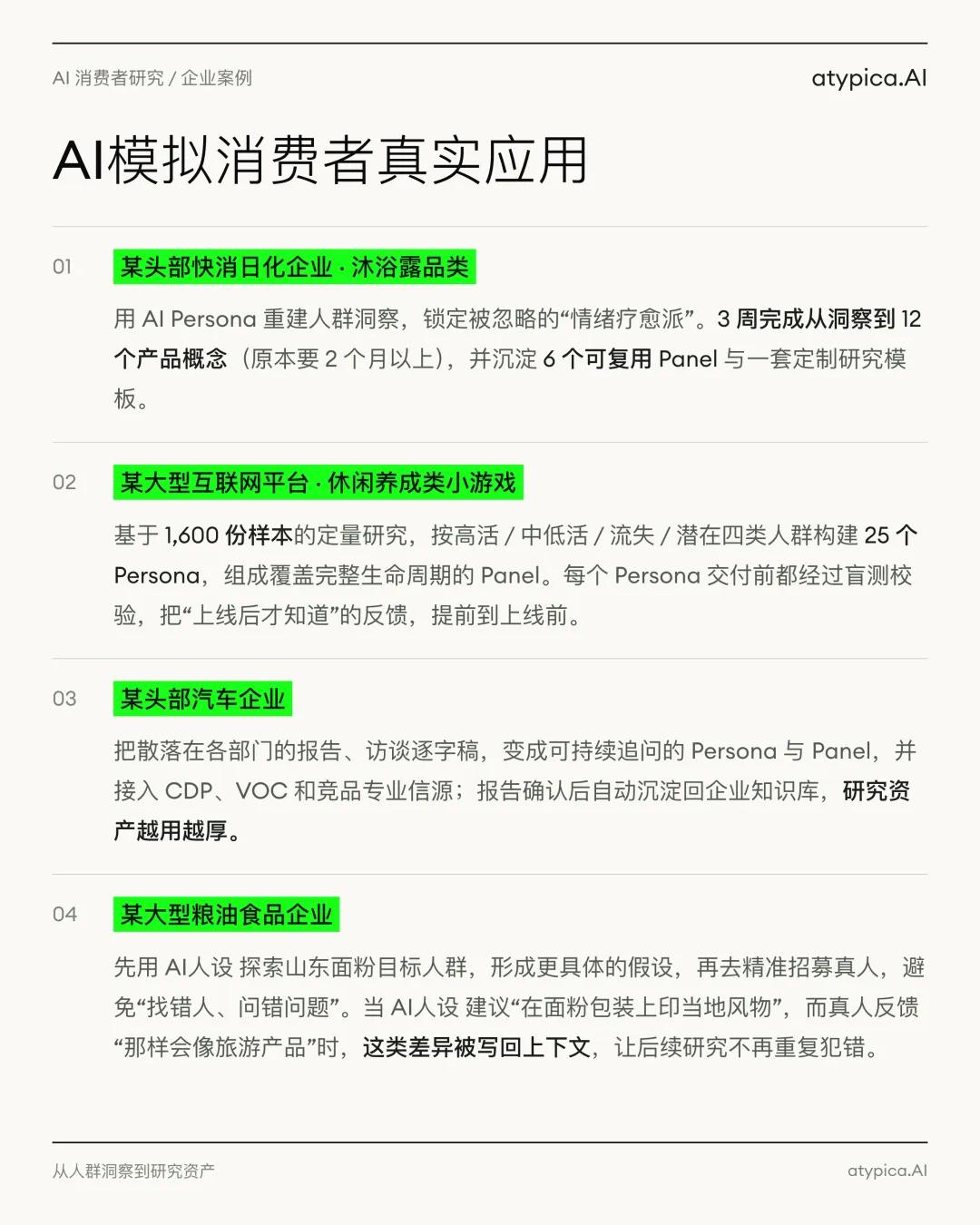
This approach of "validating during construction and continuing validation during use" has already been implemented in a number of real business cases. They belong to different industries but share one thing in common: simulated consumers are not a "replacement for real decision-making"; rather, they are repeatedly validated in real people and real business contexts before entering decision-making to provide long-term value across more scenarios.
Regarding simulated consumers, the most valuable discussions should not stop at "can they replace real people".
Through long-term practice, we have formed a judgment with our business clients: before real research, they help businesses explore consumers faster and broader, running through preliminary questions like "who to research, what to ask, and which hypotheses are worth validating"; while key judgments still rely on real people and actual business to confirm. A trustworthy simulated consumer must grow from real people's expressions and experiences and must be willing to undergo repeated validation by real people.
References:
1. Park, J. S., et al. (2023). Generative Agents: Interactive Simulacra of Human Behavior. arXiv:2304.03442. https://arxiv.org/abs/2304.03442
2. Park, J. S., et al. (2024). Generative Agent Simulations of 1,000 People. arXiv:2411.10109. https://arxiv.org/abs/2411.10109
3. Business Insider (2026). AI Tools Help CPG Brands Like Coca-Cola Test and Launch Ads Faster. https://www.businessinsider.com/cpg-marketers-using-ai-ad-testing-to-video-production-2026-3
Category
All
Date
2026-10-03
Read Time
13 min read
Related Recommendations

What Does the C-end Start to Roll Out Personal Agent Mean? Companies Need to Discuss AI Differently

Is Your Enterprise AI Still 'Single-Use'? How Loop Engineering Makes It Smarter Over Time