All
Context System, RAG, and Knowledge Graph: Three Approaches to Corporate Memory
RAG, Knowledge Graph, and Context System each organize corporate knowledge based on document fragment retrieval, predefined relationship traversal, and multi-layer dynamic state. The technical boundaries among them are: RAG supports Q&A, Knowledge Graph supports relationship queries, and Context System provides context for continuous reasoning and execution by Agents.
Category
All
Date
2026-08-11
Read Time
3 min read
Many companies, when asking "Should we use RAG or Knowledge Graph?", are actually asking a more fundamental question: How does AI remember things about our company?
All three technologies are dealing with the issue of "how to enable AI to use corporate knowledge", but their assumptions, capability boundaries, and applicable scenarios are completely different.
Assumption of RAG: Answers exist in documents
The logic of RAG (Retrieval-Augmented Generation) is: vectorize your corporate documents, and when AI needs to answer a question, first retrieve the most relevant fragments, then generate the answer.
The problem it solves is: large models do not know about your company's internal matters, but you have documents that can be temporarily fed to it.
This logic works well in document retrieval Q&A scenarios—"What are our company's travel reimbursement standards?" "Where are the terms of this contract?" But it has a fundamental assumption: the answer exists in a certain fragment of a document.
Once it goes beyond this assumption, RAG struggles. "What is this client's current decision-making tendency?"—this is not in any document; it is in historical conversations, quotation records, service tickets, and the models inferred by AI from these signals. "What pitfalls did we encounter in similar projects last time?"—this requires structured reasoning across multiple project documents, which cannot be provided by fragment retrieval.
Assumption of Knowledge Graph: Relationships can be predefined
Knowledge Graph attempts to address the relational reasoning weaknesses of RAG: explicitly modeling the relationships between entities so that AI can navigate along these relationships.
It is strong in certain scenarios: the drug-disease-symptom relationships in medical knowledge bases, the part-process-inspection relationships in manufacturing. These relationships are relatively stable, can be manually defined, and once defined, the query accuracy is very high.
However, most relationships in corporate business are not stable—customer relationships change, product iterations change, team structures change. Knowledge Graph requires continuous maintenance, and the maintenance cost rises exponentially with complexity. Moreover, it describes "what is related to what", not "what these relationships mean in this specific business context".
Assumption of Context System: Corporate knowledge is dynamic, multi-layered, and inseparable from execution
Tezign's Context System addresses a different question: not "how to retrieve corporate documents", but "how to ensure that AI Agents are always based on the real state of the enterprise when executing tasks".
It includes several layers:
Static context: brand DNA, product definitions, market positioning—these are relatively stable, akin to "the constitution of the company".
Dynamic context: customer status, project progress, competitor dynamics, market signals—these are continuously updated and serve as the working foundation for each execution.
Reasoning context: AI Persona (user/customer models built on real data), historical decision patterns, capability boundaries—these are not found in any single document but are extracted from a multitude of signals.
The core design of the Context System is not "storage and retrieval", but "a single source of truth for the Agent's execution". When a Proactive Agent is executing a task, it is not retrieving documents, but reasoning within the context of the Context System: what this brand's customer should do at this point in time.
Applicable boundaries of the three
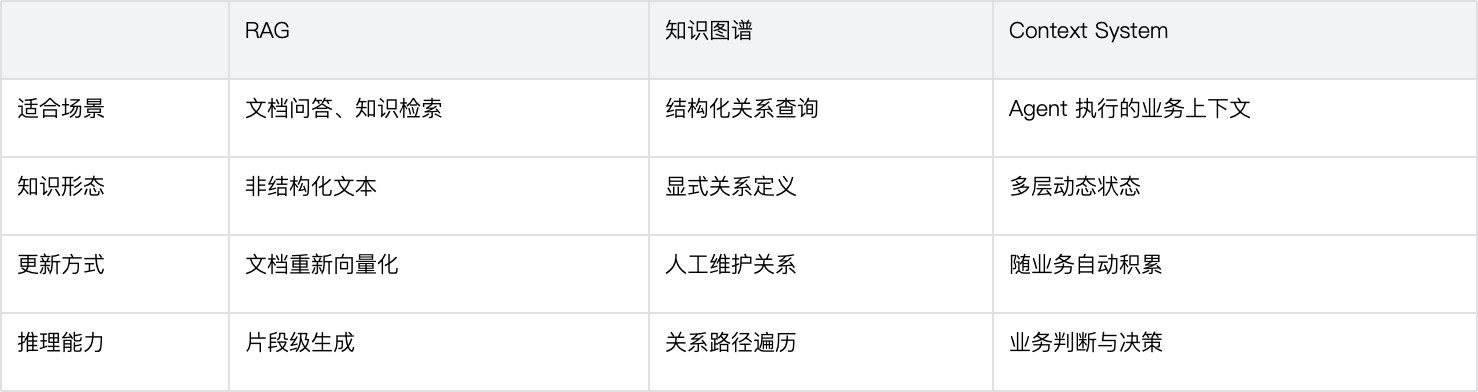
The real issue for enterprises is not which technology to choose, but clarifying what role AI plays in your business.
If AI is a high-level search engine, RAG is sufficient. If AI is a query tool that needs to understand complex relationships, Knowledge Graph is valuable. If AI is an Agent that needs to operate continuously, proactively execute, and make judgments based on the real state of the enterprise, then what is needed is the Context System—not storage, but the cognitive foundation for the Agent.
Category
All
Date
2026-08-11
Read Time
3 min read
Related Recommendations

How Long-Horizon Agents Solve Complex Business Problems That AI Workflows Can't Handle?

Does Harness Have a Shelf Life of Only Six Months? Why Enterprise AI Products Can't Be One-and-Done