All
divergent reasoning: Creativity is not generated, it is inferred
Mainstream reasoning models excel at converging toward unique solutions but struggle with open-ended business creativity. In contrast, Tezign's Creative Reasoning Model adopts a tree-structured workflow—diverging before converging—and employs a process reward mechanism. It specializes in exploring possibilities within creative decision-making, addressing a critical gap in training AI for divergent thinking.
Category
All
Date
2026-08-04
Read Time
4 min read
Those who use AI for creative tasks have all encountered the same problem: no matter how the prompt is written, the output content is highly similar in perspective. Ten slogans are essentially ten variations of the same direction. This is not due to poorly written prompts, but rather the systematic limitations in the structural design of most reasoning models.
The training objective of mainstream reasoning models (including OpenAI's series, DeepSeek-R1, etc.) is convergence: given a problem, reason step by step to find the one correct answer. This design is suitable for mathematics, code, and logic—these types of problems indeed have a unique correct answer, and the faster the convergence, the better.
However, most business problems do not have a unique correct answer:
• What should this product be named? • What is the real insight of this communication? • How to explain the price increase to existing customers?
The value of these types of questions lies not in quick convergence, but in how many real possibilities you can see—including 'what if our premise is wrong?'
The core design principle of Tezign CRM (Creative Reasoning Model): diverge first, then converge.
Its workflow is a four-step tree structure: Extract → Diverge → Expand → Converge:
Extract: Extract core variables from the input brief—target audience, brand constraints, available assets, key tensions;
Diverge: Expand along multiple paths simultaneously, exploring different directional hypotheses in parallel. For a CMO's product launch brief, CRM will simultaneously explore: what if we skip traditional advertising? What if the target audience is not the group we assumed? What if the entire strategy of a competitor is based on a false premise?
Expand: Deep dive into each path, truly exhaust the possibilities of each direction, rather than stopping at the first 'sufficient' answer;
Converge: After sufficient divergence, integrate feasibility, brand constraints, and objectives to converge on the highest value path.
This capability is what differentiates us.
CRM is Tezign's self-developed 7B parameter reasoning foundation model (the first creative reasoning model for business decision-making in China, registration number 202510170089). Its training is divided into three stages:
Domain Pre-training: Based on Tezign's accumulated proprietary corporate creative corpus, allowing the model to truly understand the business context—not general internet data, but real brand strategies, creative decisions, and market research.
Expert SFT: The key lies in Creative Trajectory data. This is a complete record of decision paths from Tezign's real projects over the years: starting from the initial brief, to expert judgments at each key node (why choose direction A instead of B), to the final delivery—not just 'problem → answer' pairs, but a complete divergence → convergence reasoning process. Currently, over 10,000 expert-labeled reasoning path pairs have been accumulated.
This data is a fundamental competitive barrier: what can be crawled online are the final posters and copy, but the reasoning processes behind experts choosing a certain direction at each fork cannot be crawled. This only exists in real project archives—and Tezign's years of corporate service accumulation is precisely this data.
Trace + PRM (Process Reward Model): CRM does not reward the correct final answer (there is no standard answer for creative tasks), but rewards good reasoning processes (Trace)—whether each step of divergence is effective, whether it is based on evidence, and at which fork point it converges for what reason. Rewards are based on the process, not the result. This is the fundamental difference between the Process Reward Model and ordinary RLHF.
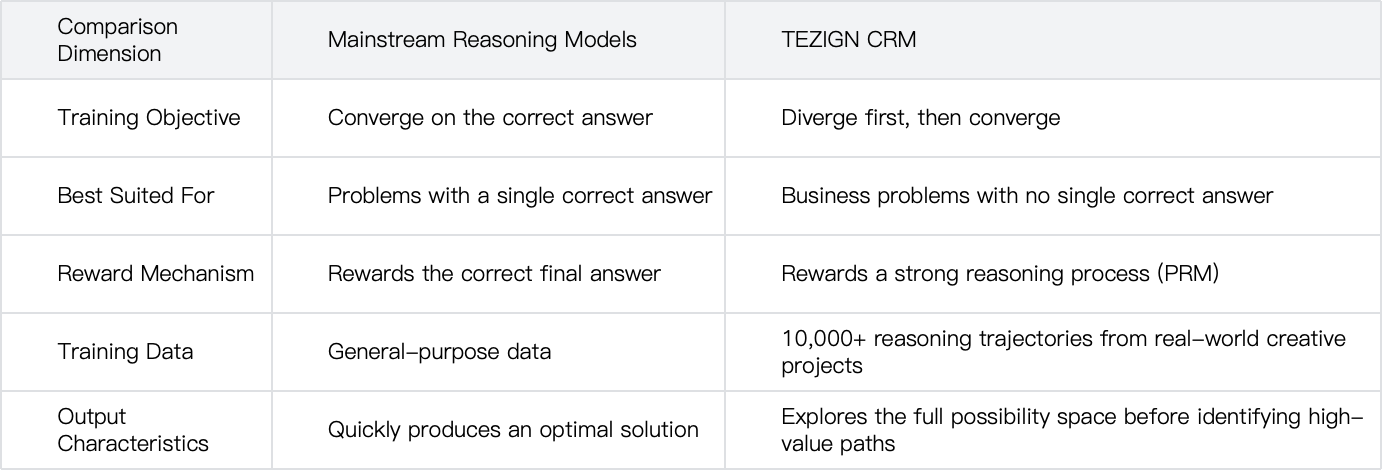
In blind tests, CRM was chosen 92% of the time compared to solutions using general foundational models alone (an increase from 77% the previous year).
The competition for creative capability is essentially a competition for data accumulation.
What general large model vendors lack is not computing power, but the process data of real corporate creative decision-making. What can be crawled on the internet are results, but decision paths are not available. Tezign's years of corporate service accumulation is precisely this data—this is a moat in model capability, and it continues to grow with each new project completed.
This is the core technological bet of Tezign CRM in the direction of divergent reasoning: not relying on larger parameter scales, but on better training data and more accurate training objectives, to build reasoning capabilities truly suitable for commercial creative scenarios.
Category
All
Date
2026-08-04
Read Time
4 min read
Related Recommendations

How Long-Horizon Agents Solve Complex Business Problems That AI Workflows Can't Handle?

Does Harness Have a Shelf Life of Only Six Months? Why Enterprise AI Products Can't Be One-and-Done