All
How Can Long-Term Intelligent Agents in Enterprises Maintain Trust in Production Environments?
Tezign GEA innovates an enterprise‑grade AI agent evaluation system. It distinguishes between academic and production‑oriented AI evaluation approaches, leverages the HarnessEval reasoning architecture and Game Lab human‑player game calibration capability, and builds a sustainably‑iterative trusted operation closed‑loop for agents based on business failure modes.
Category
All
Date
2026-08-20
Read Time
6 min read
Technical Positioning of This Article:This article takes GEA's evaluation engineering practices in insight research scenarios as a starting point to systematically explore the methodology of complex agent evaluation. As a core module of the Evaluation capability built into Harness by Tezign GEA, agent evaluation is responsible for continuous performance assessment and business outcome validation of agents operating in production environments. Mastering this methodology is key to understanding how enterprise-level AI agents maintain trust in production environments.
AI's capabilities are becoming stronger, but how do you know it is really doing the right thing?
Recently, the first HarnessEval evaluation system was released, which also raises an intriguing proposition: the evaluation itself should also be an intelligent agent that can reason.
The core of HarnessEval is a four-step reasoning chain—Plan (understand the case first, then decide what to measure) → Route (dynamically select evaluation skills) → Decompose (break down abstract judgments into verifiable sub-questions) → Verify (audit evidence first, then deliver scores)—ultimately delivering not just scores, but a traceable Evidence Tree.
This is a valuable technological leap, enabling the evaluation system itself to possess reasoning capabilities, rather than just executing fixed rules.
However, it only touches on half of the AI evaluation problem.
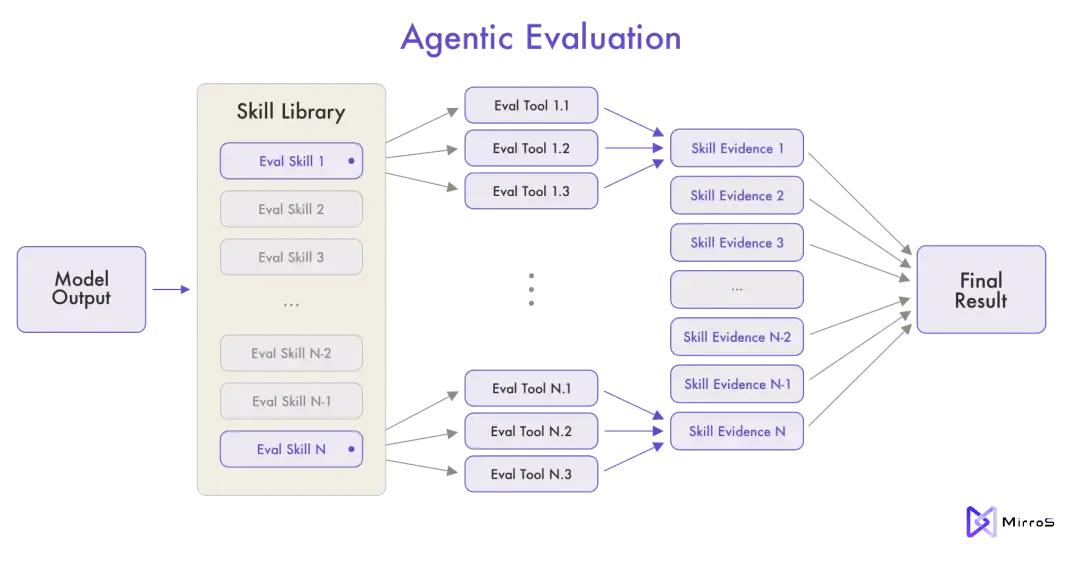
Evaluating complex agents, the hardest part is not finding smarter judges
If HarnessEval addresses the question of "how to make the evaluation system itself smarter," this is the academic perspective on model evaluation. The challenge in enterprise production environments, however, is another dimension.
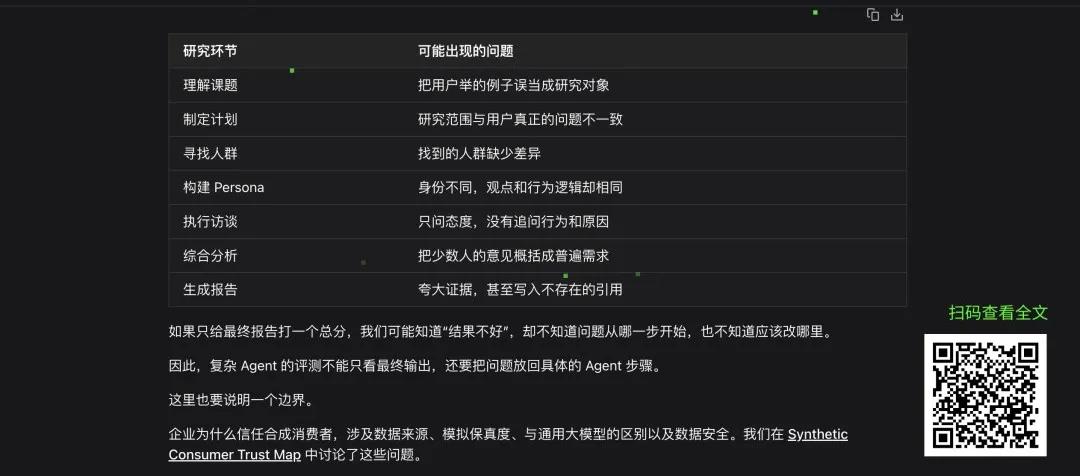
Tezign GEA can autonomously recruit consumers, conduct interviews, synthesize insights, and write reports in insight research scenarios, based on a subjective world model. In real operations, two types of failures were encountered that did not appear in any benchmark: the first type is "participant convergence"—eight respondents with vastly different backgrounds gave almost identical answers, even their reasoning and wording could be interchanged; the second type is "illusion citation"—a quote from a respondent appeared in the final report, but no one had said that in the interview records.
These two failures were discovered only after the agent completed real projects and human experts reviewed the results. You cannot just look at the final output; you need to pinpoint the earliest step where the problem occurred—this is the core challenge of evaluating complex agents.
*Scan the code to view the complete analysis of this article, atypica and insight research GEA are based on the same technical foundation.
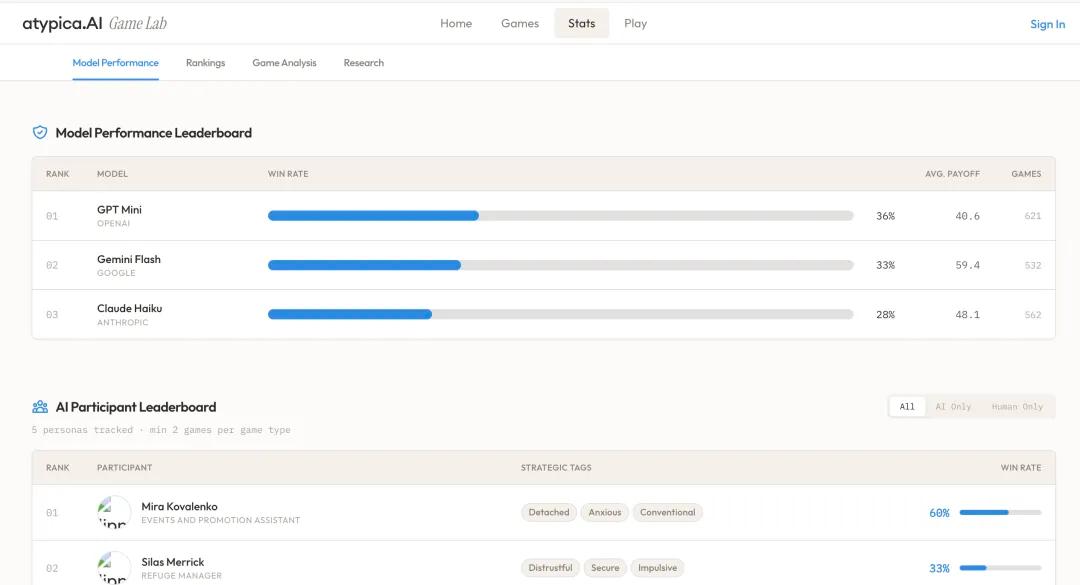
Game Lab: Calibrating AI Behavior with Real Human Game Play https://game.atypica.ai/
In insight research scenarios, GEA made a key systematic investment at the evaluation infrastructure level: Game Lab.
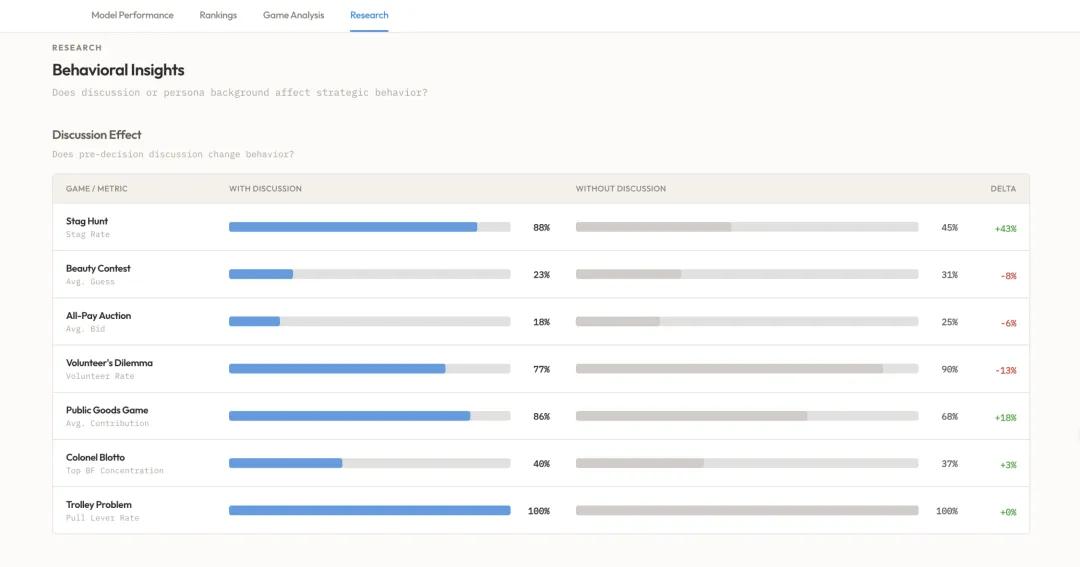
Game Lab is the core evaluation and calibration module of insight research GEA, aimed at solving the accuracy problem of AI simulating human behavior. Its working method is: allowing real human users to participate in the same economic game (such as the trolley problem, ultimatum game, etc.) as the AI agent (AI Persona), comparing the decision data of both.
The core insight of this design is: the output of language tasks is difficult to verify, but behavioral decisions have quantifiable benchmarks. When the decision distribution of AI in game scenarios shows systematic deviations from real human samples, it can precisely locate where the AI Persona is distorted in judgment and continuously fine-tune the model using real behavior data generated by humans—the goal is to make the AI's decision logic infinitely close to that of real humans.
Game Lab provides a unique advantage to the evaluation system of insight research GEA: not only relying on language models to judge language models, but also introducing real human behavior data as anchors. This is not common in current mainstream evaluation schemes.
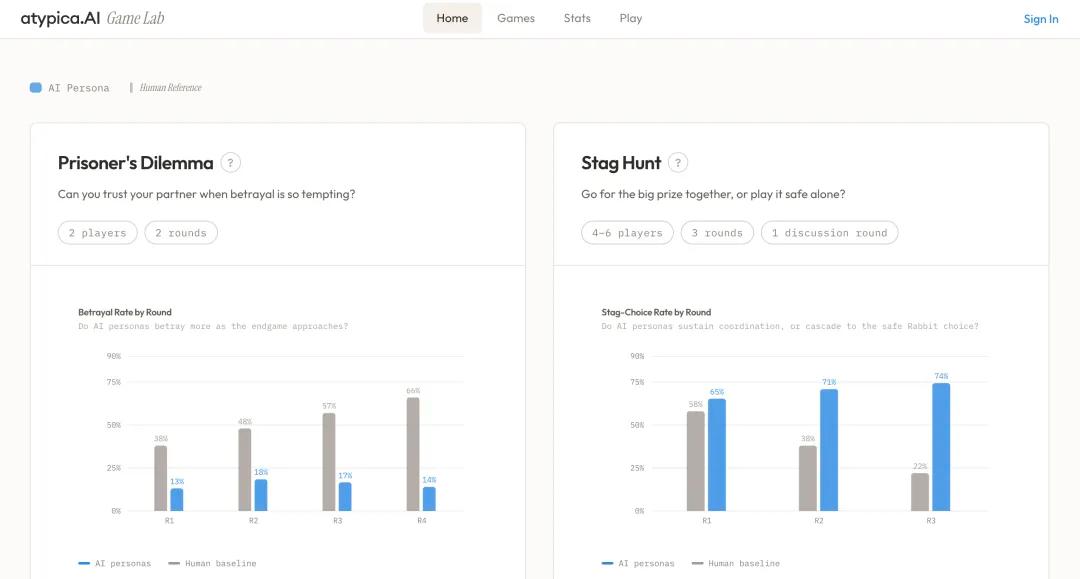
Game Lab is the core evaluation and calibration module of Tezign's insight research GEA (also used for atypica), aimed at solving the accuracy problem of AI simulating human behavior. Game Lab continuously fine-tunes the AI model using real behavior data generated by humans, quantifying the calibration accuracy of AI simulations of real humans, with the goal of making the AI's decision logic infinitely close to that of real humans. Game Lab, as a key evaluation means, ensures the reliability of this simulation system in commercial research, user insights, and other scenarios.
Starting from "Where is it Untrustworthy" Rather Than from "Metrics"
In specific evaluation engineering practices, insight research GEA made a counterintuitive choice: not starting from designing evaluation metrics, but from the real feedback of experts—adding feedback entry points next to each execution step, allowing experts to describe in their own words what problems they discovered, rather than just scoring.
When similar feedback appears multiple times, it can be summarized into a Failure Mode—a type of systematically identifiable defect, accompanied by precise definitions: what counts as a failure, what does not, and what evidence is needed. The discovery of failure modes is convergent: the first day of intensive expert review often uncovers dozens of new modes, which then decrease daily, and after a certain point, almost all new feedback can be categorized into existing types—this is a signal of entering the automation phase.
Once in the automation phase, the division of labor becomes clear: humans are responsible for discovering and defining problems, while LLM is responsible for large-scale detection of known issues. Each evaluation task corresponds to a failure mode and must retain supporting evidence: conclusion determination + specific citations triggering the determination + boundary cases requiring human confirmation. Traceability is trustworthiness—this is consistent in spirit with the Evidence Tree of HarnessEval, but the application scenario shifts from model capability evaluation to business execution quality evaluation.
From "Evaluation" to "Continuous Trustworthiness"
Currently, there are two divergent paths in the field of AI evaluation. One is the academic route, pursuing the intelligence of the evaluation system itself (such as the reasoning chain + Evidence Tree of HarnessEval); the other is the production operation route, aiming to continuously capture failures and calibrate in real business execution.
Game Lab represents a differentiated investment by insight research GEA in the second route—using real human behavior data rather than just language models as calibration anchors, is one of the few engineering practices that can truly quantify "AI and human behavior deviations".
In Tezign's GEA system, Evaluation, as one of the core capabilities of Harness, aims to add a layer of closed-loop in the enterprise production environment on top of these two routes: evaluation results are not just output reports, but feedback back to the agent, driving continuous optimization—ensuring that AI agents are not only trustworthy in testing environments but also maintain trustworthiness in every real business execution.
We believe that the core challenge of enterprise-level AI evaluation is not "finding smarter judges," but establishing an operational mechanism that can continuously evolve with the agent. Evaluation is not a one-time quality inspection, but a component of business operations.
AI evaluation is transitioning from "score ranking" to "continuous trustworthiness"—this is not a project that can be done once and for all, but a capability that needs to grow together with the agent.
Category
All
Date
2026-08-20
Read Time
6 min read
Related Recommendations

Does Harness Have a Shelf Life of Only Six Months? Why Enterprise AI Products Can't Be One-and-Done

What Does AI Rely On to Determine 'This Reasoning Path is Correct' When Performing Reasoning Tasks?