All
The Cost of Multi-Agent Collaboration Remains High; the Biggest Driver May Not Be Tokens, but Orchestration
In enterprise Agentic AI transformation, the often-overlooked handoff tax can erode budgets. It stems from transmission, synchronization, and retries, and can be optimized through structured handoff artifacts. The core of cost competitiveness lies in internal collaboration and orchestration capabilities.
Category
All
Date
2026-11-11
Read Time
11 min read
Agentic Transformation Observations
In enterprise Agentic AI transformation, the cost pain point is no longer just Token consumption. The easily overlooked handoff tax is the key reason budgets go out of control: in multi-agent collaboration, information transfer, version synchronization, and retry rework create hidden losses. The longer the collaboration chain, the greater the loss, and it is not included in model billing. Simply lowering the Token unit price treats the symptom, not the root cause; the real issue lies in handoff design. Token unit price is an industry-wide variable, while handoff loss is determined by a company’s own processes. The core of Agent cost competition ultimately comes down to internal collaboration chains and orchestration-layer capabilities.
Today, enterprise customers are shifting their focus from “can it be done” to “is it worth it, does it run stably, and how can ROI be measured.” Long-running agents, multi-agent collaboration, and frequent tool calls can significantly increase Token consumption and overall cost.
At this point, many people’s first reaction is usually to push down Token unit prices: switch to a cheaper model, shorten prompts, add caching. These actions are effective, but they only affect the most visible line on the bill. The part that truly blows up the budget happens in the middle, when one agent hands a task off to the next.
But when most enterprises budget for Agents, the spreadsheet usually has only one line: Token unit price multiplied by estimated call volume. That line can tell you how much the model cost, but not how much collaboration cost. How should enterprises respond to the “handoff tax” in Agentic AI transformation? What should enterprises use to carry handoffs? This article will focus on that question.
The part that is hard to calculate is the handoff
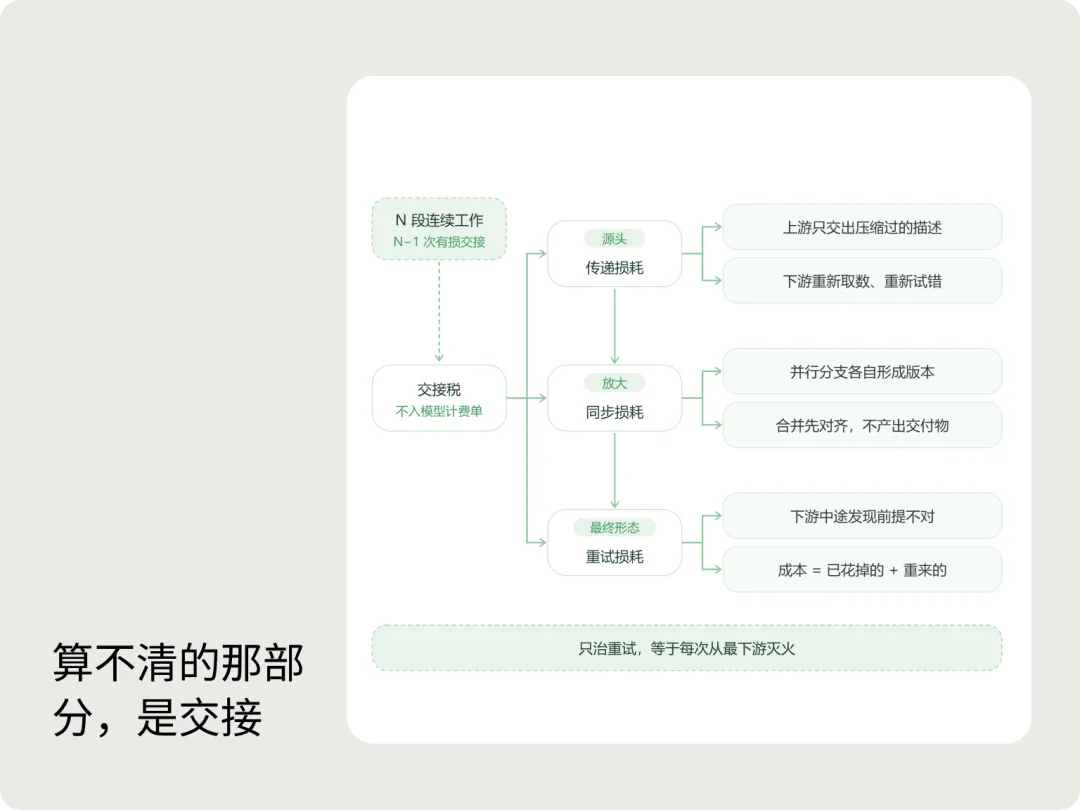
If you break down a multi-agent collaboration, the cost structure is a continuous piece of work split into N segments, with N minus 1 handoffs between segments. Each handoff is a lossy transfer.
This article refers to these losses collectively as the handoff tax: the longer the collaboration chain, the higher the tax rate, and it does not appear on the model invoice. The handoff tax consists of three parts.
Transmission loss. After the upstream agent completes a task, it passes the result to the downstream agent, but what is handed over is only a compressed description; the full working state does not move along with it. Which information must be carried forward and which can be dropped depends on how the upstream agent summarizes. If the summary is rough, the downstream agent has to re-fetch data and re-try. The calls spent on this rework are charged to the downstream agent, but the root cause is the upstream handoff design.
Synchronization loss. When multiple branches run in parallel, each may form its own version of the same object. The more branches there are, the greater the version drift. During merging, the first step is to align on “are we still discussing the same thing?” That alignment produces no deliverable, but it consumes calls.
Retry loss. If the upstream handoff is incomplete, the downstream agent may discover halfway through that the premise is wrong, then roll back, start over, and hand off again. The cost of one retry is far higher than the cost of one call, because it includes everything already spent plus everything spent again.
These three losses have a direction: transmission is the source, synchronization amplifies it, and retry is the final form it takes. Fixing only retries is like fighting a fire from the bottom of the chain every time.
Where are the boundaries of this framework?
Handoff tax applies only under one condition: the task must indeed be split into multiple segments, and those segments must be handled by different agents. And that is exactly the current reality for complex enterprise tasks.
Only when one agent does everything from start to finish are there zero handoffs, and cost is entirely determined by call volume, making unit-price reduction effective. If a task has multiple segments but is completed continuously by the same agent without state interruption, the handoff tax is also close to zero.
The truly applicable case is the third one: tasks span time, systems, and roles, must be shared by multiple agents, and each segment has different capability boundaries. Enterprise content production, knowledge translation, and marketing collaboration mostly fall into this category—if a task must keep moving forward, track versions, and maintain cross-segment consistency, someone has to hand the state over.
To determine whether a scenario falls within this framework, ask one question: is there any segment in the chain where the downstream agent, after receiving the result, needs to re-understand the upstream intent? If yes, the handoff tax is there.
Why handoffs are harder to calculate than Tokens
Tokens are measurable; handoffs are not. The invoice shows call counts and character counts, but it does not show how much of a given call was spent rebuilding what was lost in the previous handoff.
This leads to two consequences.
First, budgets are underestimated: budgets based on unit price implicitly assume that every call moves the task forward, while a substantial portion of calls are spent rebuilding state in place. There is no corresponding line item in the ledger.
Second, optimization goes off track: if the ledger only shows Tokens, all resources get bet on unit price. Switching models can lower the unit price, but if the handoff design does not change, the amount of rework stays the same, and the total bill does not drop much.
Conversely, if the handoff design is improved, the unit price may not drop at all, yet the total bill can fall sharply. In fact, evaluation systems are already moving in this direction. Sullivan’s 2026 Global Desktop AI Agent Market Research Report breaks the Product Technical Leadership Index into Agentic capabilities, Harness engineering, model adaptability and usability, and scalability and openness, with sub-items including task planning, tool calling, multi-agent collaboration, memory management, error recovery, and access control. The report does not talk about cost directly, but its evaluation items happen to cover the three sources of handoff loss: collaboration corresponds to transmission, memory corresponds to synchronization, and error recovery corresponds to retries. The evaluation system already treats handoffs as a capability, while enterprise accounting still stops at unit price.
Four actions to reduce the handoff tax
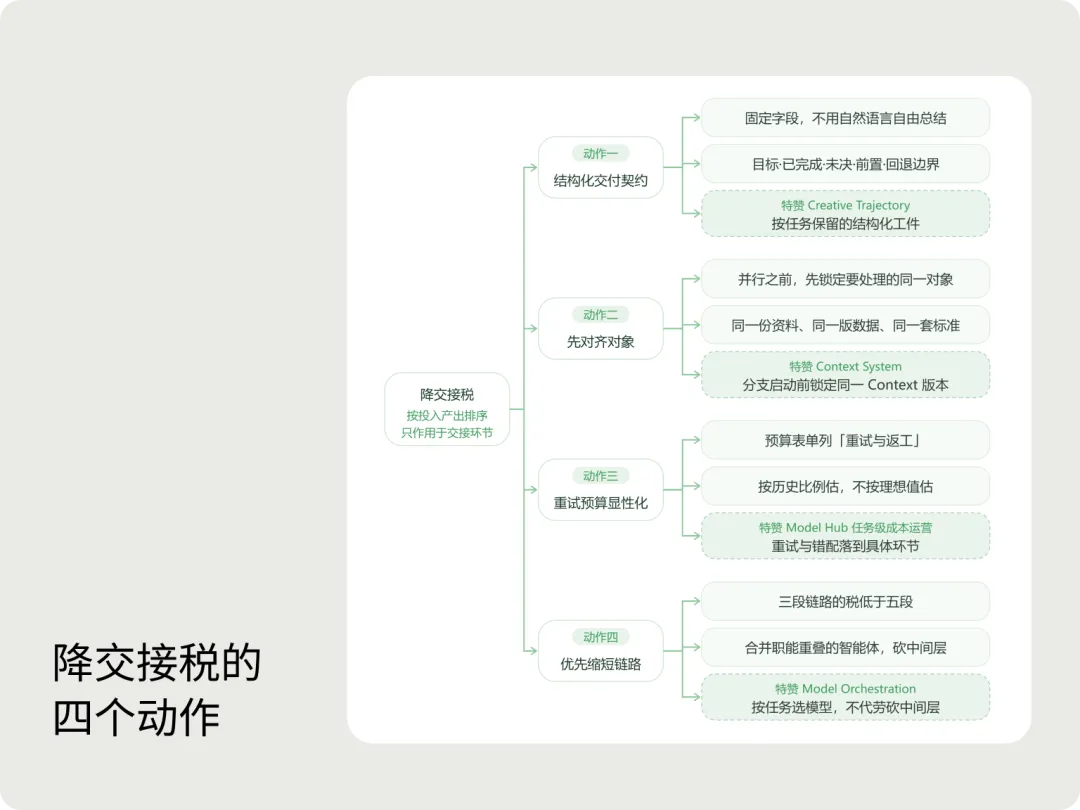
The following actions are ordered by ROI and all act on the handoff stage, not on model selection.
Action 1: Define the handoff artifact as a structured delivery contract.
Do not let the upstream agent summarize freely in natural language. Define fixed fields for each type of handoff: task objective, completed parts, unresolved parts, prerequisites needed by the downstream agent, and rollback boundaries. Once the fields are fixed, the downstream agent does not need to guess what the upstream agent meant.
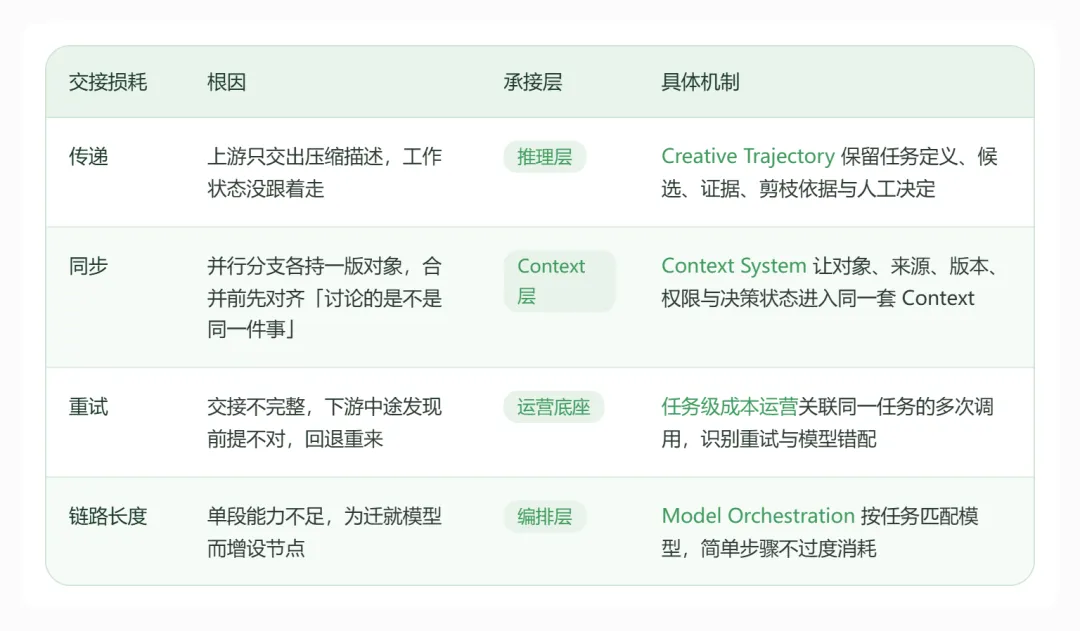
Here is an example. In a content production chain from insight to strategy to copy to review, if the four stages only pass conclusions, then when review finds the premise is wrong, the whole chain must be rolled back; if what is passed is conclusions plus rationale plus unresolved items, review can make local corrections on the unresolved items without rerunning the first three stages. The key is the structure of the handoff artifact, not its length. Tezign’s Model Hub turns the handoff artifact from “a compressed description” into “a structured artifact” through Creative Trajectory: task definition (goals, inputs, success criteria, constraints, human confirmation points), path exploration (candidates, hypotheses, evidence, counterexamples), evaluation and pruning (what is retained, merged, or eliminated and why), and human decisions (expert edits, unresolved disagreements, final selection). This is exactly the fixed-field structure needed in Action 1, except the fields are not manually set by the team; they are retained by the platform according to the task. What the downstream agent receives is a record that can be compared and reviewed, so it no longer has to guess the upstream intent.
Action 2: Align on the object before aligning on the conclusion in parallel branches.
Before running in parallel, first fix “what is the same object being handled”: the same document, the same version of data, the same set of decision criteria. If the object is the same, then disagreements in conclusions are real disagreements; if the object is not the same, every later alignment is wasted effort.
When parallel branches fail to align, it is usually not because of disagreement in conclusions, but because the objects in each branch are not the same version. Tezign organizes objects, relationships, sources, time, versions, permissions, and decision states into one unified Context by building a Context System, while preserving “which conclusions have been replaced” and “which rules only hold under specific conditions.” By locking the same Context version before branches start, there is a common basis for comparison when merging.
Action 3: Make the retry budget explicit.
Add a separate line item in the budget table for “retries and rework,” estimated from historical ratios rather than ideal values. Its purpose is to make the team see this cost; saving money is just a side effect. Costs that are invisible will not be optimized. The reason retries fail to settle into the budget is that enterprises only see the model’s total bill. Tezign’s Model Hub task-level cost operations link multiple calls within the same business task and observe total Tokens, cost, latency, retries, and model mismatch by model, application, agent, team, and task. What is identified is the retry and mismatch at a specific stage, not a year-end summary line, and it can directly become the line item required in Action 3.
Action 4: Shorten the chain first.
A three-segment chain has lower handoff tax than a five-segment chain, even if each segment slows down. Merging agents with overlapping functions and removing unnecessary middle layers is more effective than speeding up a single segment. This layer is exactly what Tezign Model Hub’s orchestration capabilities enable. Model Orchestration determines what model capabilities are needed based on task difficulty, modality, quality requirements, cost, and data boundaries: simple steps do not need a flagship model, while complex tasks are split into subtasks, combined with models, or routed through different paths. When one model is sufficient, it does not add calls. What it reduces is not the number of handoffs, but the number of times each segment is forced to outsource to a stronger model; the chain does not need to grow longer just to compensate for insufficient capability. But the boundary must be clear: orchestration solves “which model or model combination should be used,” not “can we reduce one handoff.”
What can Model Hub not do?
Tezign’s Tezign Model Hub is a divergent reasoning and multi-model orchestration platform. It does not replace an enterprise’s existing AI Gateway; the difference in positioning is that it performs reasoning and orchestration directly, rather than merely forwarding requests to a model.
It sits between agents and underlying models and does two things:
First, it performs reasoning directly—the Creative Reasoning Model breaks open-ended business problems into multiple differentiated paths, compares them across goals, evidence, constraints, and risks, and dynamically converges to output candidate paths, comparison basis, and unresolved questions. It is itself a model supply that can be called and deployed;
Second, it orchestrates tasks—Model Orchestration understands task difficulty, modality, and quality requirements, while also evaluating cost, latency, deployment, and data boundaries, and dynamically selects a single model or combines and switches among multiple models.
Mapped onto the handoff chain, it looks roughly like this layered structure:
Ultimately, the cost competition for enterprise-grade Agents will come down to collaboration design. Token unit prices are public, industry-shared numbers that anyone can access; handoff loss is determined by each company’s own processes, and every company is different. When the procurement threshold shifts from “can it be done” to “is it worth it,” the answer to that question is written in your own collaboration chain, not in the model vendor’s price list.
That is also why the orchestration layer is worth examining on its own. It does not solve bloated processes, nor does it decide for you whether a middle step should be cut—it only does two things that are harder for others to replace: it lets upstream judgments be handed over in a structured way, and it matches each downstream subtask with the right model instead of blindly choosing the most expensive one. For enterprises already running long tasks on multi-agent systems, these two things usually move the total bill more than another round of discount negotiations.
References
1. Titanium Media, “Enterprises Begin to Calculate Agent Costs More Precisely; Long-Running Operations and Multi-Agent Collaboration ROI Become the New Procurement Threshold,” 2026-10-23, https://www.tmtpost.com/8178287.html
2. Leiphone, “Sullivan’s 2026 Desktop AI Agent Report: Tencent WorkBuddy Tops Two Rankings, Harness Engineering Listed as a Core Evaluation Dimension,” 2026-09-20 https://www.leiphone.com/category/industrynews/U0o8Z4sG9l26lvTQ.html
3. Tezign official website, “Tezign Model Hub Divergent Reasoning and Multi-Model Orchestration Platform,” https://www.tezign.com/products/model-hub
4. Tezign official website, “Context System Enterprise Context Platform,” https://www.tezign.com/technology/context-system
5. Tezign official website, “Agent Reliability and Evaluation,” https://www.tezign.com/technology/agent-reliability-evaluation
Category
All
Date
2026-11-11
Read Time
11 min read
Related Recommendations

How Can Enterprises Identify the First AI Scenarios to Implement? Here’s How to Choose the First Roadmap

What Does the C-end Start to Roll Out Personal Agent Mean? Companies Need to Discuss AI Differently