Media & Press
Founder Park | Personal AI's 'Intent Capture' that Everyone is Talking About May Be What Enterprise Agents Need Most Today
The core of enterprise agents is capturing business intent, requiring the establishment of a dynamic context system to achieve the transition from humans using AI to AI using humans, prioritizing the implementation in front-end business to promote the transformation of intelligent agents.
Category
Media & Press
Date
2026-10-22
Read Time
15 min read
The core change in this wave of Personal AI may be the change in delivery form.
In the past, general agents were more like 'single-task delivery.' You had to think clearly about what you wanted to do and give it a clear instruction. For example, 'Help me write a web scraping code' or 'Organize this spreadsheet into a chart,' it would help you complete this delivery well, and the task would be considered finished.
But today's Personal Agents want to align with the user's intent.
When the user hasn't fully figured out what they want to do, the agent must capture that vague intent and judge and plan suggestions for the user based on this state. A series of subsequent actions and solution judgments are actively completed by the agent, which is something that past ChatGPT or single-task agents could not achieve.
If we look at this change in product form in the enterprise context, it can explain the confusion many business managers have today: why has the company adopted large models early on and reimbursed employees for various AI tools, yet everyone still feels that 'the company doesn't seem to be more efficient because of AI'?
The reason lies here. Internally, handling individual data well and polishing a single document is merely completing an isolated task delivery with AI. However, doing a single task well and 'achieving the business goals of the enterprise' is separated by a huge gap.
The implementation of AI in many enterprises still remains at the stage of 'equipping everyone with a Copilot,' essentially just inserting a Q&A tool into the existing workflow, with no changes to the process itself. What enterprises truly lack is not the 101st AI tool, but an evolutionary path similar to 'enterprise-level Personal Agents.'
When enterprises need not just a single Q&A assistant but a truly intelligent agent that can understand business intent and proactively drive business, the industry is forming a new consensus—moving from simple 'tool efficiency' to Agentic Transformation: the next stage of enterprise AI is no longer about buying a smarter Copilot, but about letting AI truly understand the intent of the enterprise, entering real business scenarios, participating in complex judgments, and proactively and long-term driving business results.
01 Selling an Agent to Enterprises is Easy, Capturing 'Enterprise Intent' is Difficult
Recently, we have communicated with many entrepreneurs in the ToB service sector, and everyone has a very consistent feeling: today, integrating DeepSeek or any large model into the enterprise intranet, or selling a ready-made AI app or general agent to enterprises, has no barriers at all.
The real first step that holds everyone back is: how to help enterprises clarify their business goals, workflows, and historical data, and align these with the agent so that the agent can accurately capture 'enterprise intent'?
On the personal side, capturing intent only requires understanding a person's habits; but on the enterprise side, intent is hidden in complex organizational rules, approval permissions, business processes, and countless past trial-and-error experiences. If AI is just an 'enterprise version of ChatGPT,' it will never automatically 'remember' your business just because you use it more. When 100 employees each open a dialogue box to ask the general model questions, due to the lack of alignment with enterprise-level context, the results are often a pile of incompatible sand, and this transformation is likely to remain shallow.
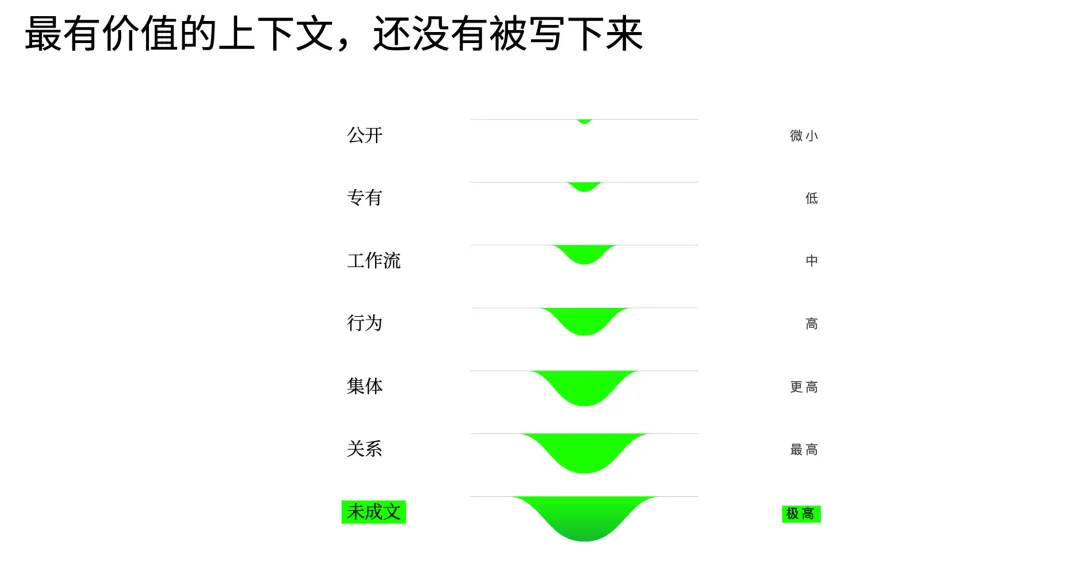
Faced with this bottleneck, many enterprises easily fall into another misunderstanding: since buying ready-made general tools doesn't work, does the company need to hire an algorithm team to build its own agent from scratch?
Here, we actually need to separate two things that are often confused: Enterprises do not need to build their own agents, but they must build their own intelligence.
1. An agent is an execution structure: running tasks, adjusting models, connecting systems, these belong to the engineering-level infrastructure, which can be completely purchased, rented, or built by external professional teams;
2. Intelligence is an enterprise asset: the experience, judgment standards, and operational mechanisms accumulated by the enterprise in real business must be embedded within the enterprise's own system boundaries and owned by the enterprise itself.
The speed of model iteration is extremely fast; the model capabilities bought at a high price today may depreciate with tomorrow's upgrades. The generic capabilities purchased will not constitute any barriers for any enterprise. But the business experience of the enterprise is scarce—execution can be outsourced, but accumulation cannot be outsourced. Only by keeping every business judgment and effective method within its own system can it compound over time, becoming a proprietary intelligence that understands the enterprise better the more it is used.
So, how should an enterprise's experience be retained in the system to become 'context' that the agent can understand?
In the past two years, many teams have simply equated the enterprise context with creating a knowledge base retrieval (RAG), stuffing the company's rules and historical documents into a vector database. However, in real business, rigid static documents do not represent the enterprise's judgment logic.
Industry practitioners who are truly at the forefront have realized that what enterprises need to build is a dynamic Context System, and the most core data barrier that generic model vendors cannot access is the Creative Trajectory generated during business flow.
This system records not just the final delivery of a poster, a video, or a project proposal, but the entire business context behind the production process: what business goal initiated this material? Why were the first three versions overturned? What brand standards, compliance permissions, or aesthetic judgments were followed behind each modification? After being launched in the market, which version had the best real conversion effect?
To ensure that these implicit experiences, originally scattered in the minds of business experts, are truly retained, the delivery methods in the ToB field are also changing—more and more cutting-edge teams are beginning to adopt the FDE (Forward Deployed Engineer) on-site delivery mechanism. In the process of building intelligent agents deeply in business scenarios, the judgment logic and work paths of experts are gradually structured and mechanized into the system.
When the project delivery is completed, this entire context system remains within the enterprise's own boundaries. This not only allows the agent to truly align with the enterprise's rules, permissions, and historical intent, but also the accumulated industry know-how is simultaneously the most scarce source of high-quality corpus for post-training of the model. The intelligence of the enterprise is no longer a one-time static project but begins to automatically accumulate compound growth with each day's business operations.
02 Rewriting Work Methods: From 'Humans Using AI' to 'AI Using Humans'
When the agent truly aligns with the enterprise's business goals and data context and can understand 'enterprise intent,' what changes will occur within the organization?
In enterprises that have been implemented, the most intuitive change is: the collaborative relationship between humans and AI is reversing—from the past 'humans using AI' to 'AI using humans.'
Looking back at the past two years of the Copilot model, or the way most people are accustomed to collaborating with agents, the underlying logic is still 'humans using AI.' Humans dominate the entire workflow: humans break down tasks, humans write prompts to invoke AI, generate a piece of text or an image, and then copy and paste it into the next software to proceed with the process. In this process, AI is merely a tool for enhancing the efficiency of a specific employee; once the employee closes the computer, the task also comes to a halt.
But under the operational form of Agentic Transformation, this way of working is completely rewritten:
Enterprises only need to provide a business intent; the subsequent tasks are no longer pushed by employees step by step, but rather AI itself runs tasks in the background, breaks down goals, makes plans, and promotes execution; only when encountering key nodes in the execution process—such as needing human subjective judgment, aesthetic choices, or risk approvals—does AI actively 'call' humans.
This reconstruction of the relationship from 'humans using AI' to 'AI using humans' changes not just an individual's typing speed, but the entire organization's execution structure, how tasks are broken down, how they are promoted across departments, and how they are ultimately delivered, all have a new operational form.
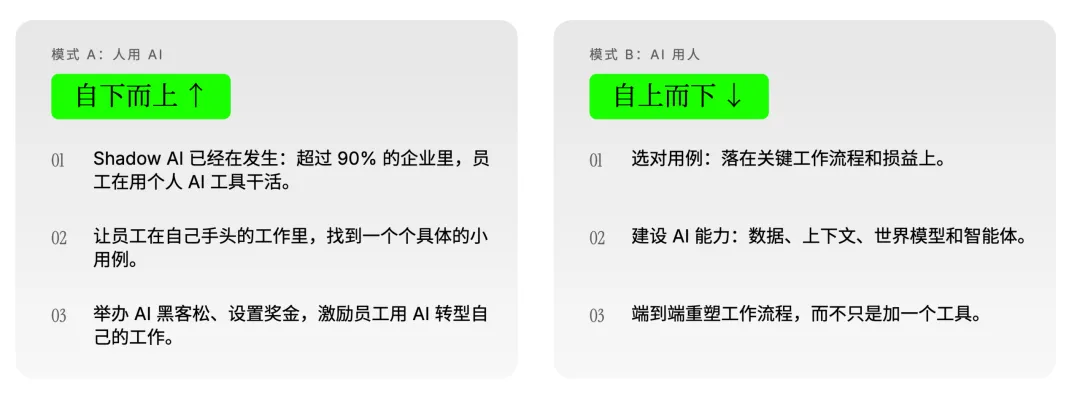
To support the 'AI using humans' collaborative model, relying on a single Q&A-style assistant is clearly insufficient; it relies on the long-term intelligent agent operational mechanism (GEA / Proactive Agent) built by Tezign, a more proactive agent.
Under this mechanism, the agent is no longer like an employee who only moves when asked; it operates like a team running 24/7 in the background. It has the ability to hold intent across days: during business cycles lasting several days or even weeks, it clearly remembers what the initially locked business goal was, recalls which paths and solutions were tried yesterday and why they were rejected, and based on this, actively plans the next steps, calling in the corresponding human experts for confirmation at the right time.
Humans step back from the execution layer and remain at the judgment nodes.
Letting AI run planning in the background also raises a concern: will the final output be just mediocre average solutions?
After all, the essence of traditional large models is probability convergence. Take a typical business scenario: when a CMO of a consumer brand wants to develop a communication strategy for a new product launch, conventional reasoning models will provide an 'optimal solution' based on historical data and best practices—reasonable and safe, but likely mediocre.
To break this average trap, the cutting-edge technological evolution direction is to introduce divergent reasoning models (Creative Reasoning Model). When facing complex business issues, these models will first expand possibilities: what if traditional advertising is not done? What if the target audience is not the group you think? What if the competitor's strategy is based on a false assumption? After expanding, they will converge on the most valuable path.
In the initial stages of task orchestration, divergent reasoning models will actively include 'low-probability events' in the solution space—first, like top creative teams brainstorming, they will diverge non-consensus options, exploring multiple unusual possibilities, and then combine with the enterprise's Context System for feasibility assessment and convergence.
This also means that the training methods for these models must differ from conventional practices. They cannot rely solely on ordinary generic annotations but need to involve strategy consultants, creative directors, brand experts, and market researchers who have made real business decisions for in-depth annotations—they are not just marking the correctness of the answers but also the 'value of the thought paths': which directions are worth exploring, which possibilities are most easily overlooked, and which assumptions need to be questioned. The core goal is to help enterprises explore non-consensus directions that human teams might miss due to limited energy.
03 The 'Minimum Closed Loop' for Medium and Large Enterprises is in Front-End Business
After clarifying how to 'align enterprise intent' and 'how employees collaborate with AI,' the next question for enterprise decision-makers to consider is: in implementing agents within the enterprise, which scenarios or businesses are suitable, or should they integrate everything from the start?
This is very similar to the challenges faced by Personal AI today.
Whether it's a large corporation or a startup, everyone envisions Personal Agents taking over a person's life and work comprehensively; but when actually pushing to the market today, almost everyone has chosen extremely specific and high-frequency closed-loop scenarios like 'helping you book flights and arrange travel' to take the first shot.
The transformation of enterprise agents follows the same logic.
Every CEO ultimately wants the agent to understand what the entire company is doing, helping the whole company achieve comprehensive efficiency and business acceleration. But the problem is, today no medium or large enterprise can achieve AI implementation across all departments and all employees at once.
In the past two years, many AI projects in medium and large enterprises have been slow to see results or even abandoned, often not because the technology is inadequate, but because 'the first shot was fired in the wrong place,' attempting to make large-scale transformations from the outset or directly tackling the company's most complex and burdensome core systems. As a result, they fall into a long engineering quagmire, with long cycles and slow feedback, and before they can produce business results, internal confidence and budgets have already been exhausted.
From the practical experiences emerging from medium and large enterprises, the smartest approach is to first find the most typical 'minimum closed loop (MVP)' that can yield results the fastest.
What kind of business scenarios qualify as the ideal 'minimum closed loop' for medium and large enterprises? The core can be measured by three standards:
1. Context is easiest to collect and retain: This scenario generates high-frequency business actions and feedback every day, capable of quickly gathering scattered data and judgment trajectories, becoming the starting point for the growth of the enterprise Context System;
2. Technology and scenario are highly compatible, closest to business goals, and yield results the fastest: There is no need to overturn the old infrastructure from the ground up; the agent's capabilities can smoothly land in this scenario and quickly produce measurable business results, helping the team gain internal confidence for continued investment;
3. Department employees can quickly achieve a new state of 'human and AI collaboration': The team in this business line has a high acceptance of new tools and new working methods, able to quickly run through the previously mentioned 'AI long-term promotion + human judgment at key nodes' cooperation.
Using these three standards to filter within the enterprise will yield very clear answers: the results of enterprise AI often emerge not from the most standardized process automation in the back end, but from front-end business scenarios—primarily 'marketing' and 'product innovation.'
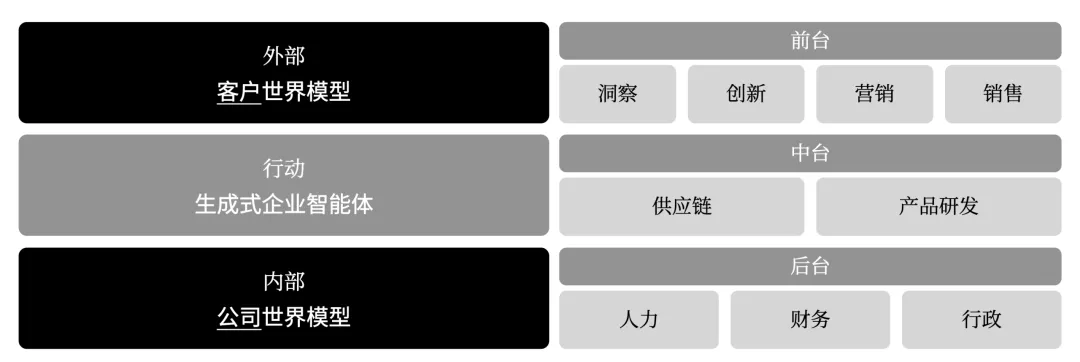
Why are front-end scenarios preferred?
On one hand, typical front-end scenarios, whether user insights, new product selection projects, e-commerce content production, or brand communication, are closest to consumers, with the fastest market feedback and the easiest business results to perceive directly; but more critically, marketing, content, user insights, and new product innovation are not purely mechanical labor but are where 'judgment density is highest.'
If AI is only helping finance or administration automate processes in the background, it only proves to the company that 'AI can do the drudgery (efficiency)'; but if AI can first run through the minimum closed loop in front-end scenarios facing consumers, it proves to the entire organization that 'AI can participate in real business judgments (judgment quality).' Once judgment quality is validated in the front end, management's imagination and confidence in investing in agents will be completely opened up.
These scenarios test whether AI 'truly understands humans.'
What kind of visual aesthetics do consumers prefer? What kind of narratives can resonate with specific circles? Which design elements will emerge on social platforms this fall and winter? These questions have no cold, hard standard answers; they are all complex subjective judgments concerning aesthetics, preferences, taste, and professional experience.
To cross this threshold, relying solely on the objective knowledge of generic large models is far from enough; it is essential to complement the modeling of the human subjective world. Tezign's solution is to approach from the perspective of human-machine interaction, training a Subjective World Model based on millions of real user data, conducting layered modeling of human expression, narrative, cognition, and behavior, enabling AI to simulate and understand consumer aesthetics, preferences, and complex judgments. This is a key step for AI to move from 'being able to work' to 'understanding people' and thus qualify to participate in commercial judgments in the enterprise front end.
From the previously dissected enterprise context system, long-term and divergent reasoning mechanisms, to the underlying understanding of 'humans,' Tezign has completed a full-stack layout through long-term commercial practice.
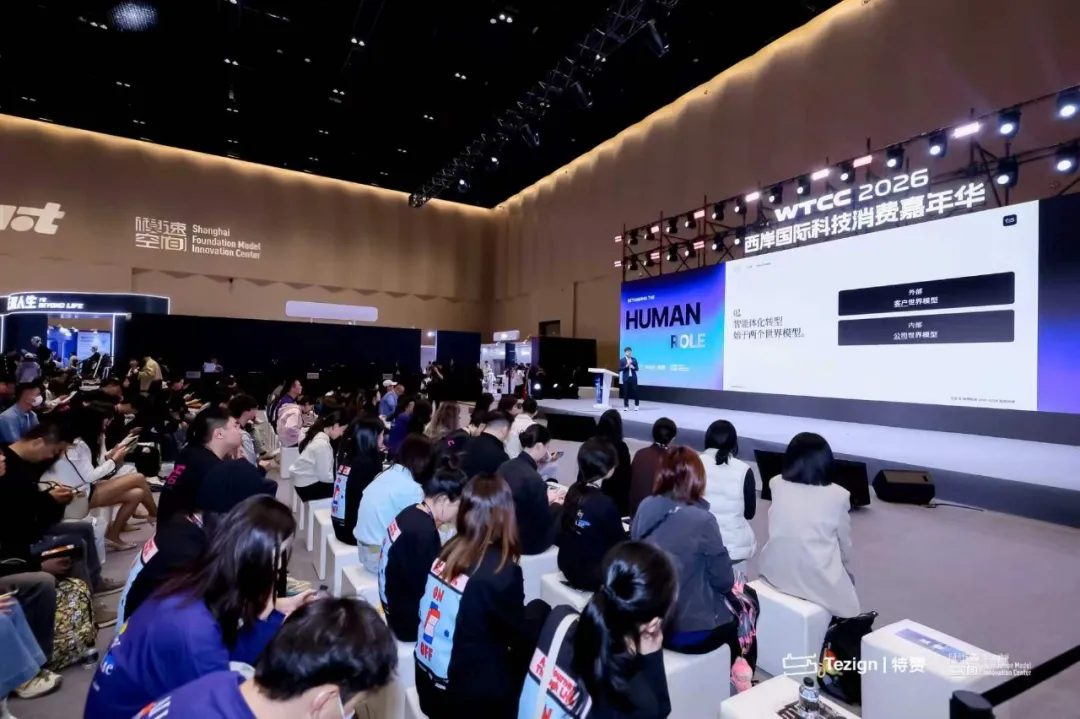
At today's WTCC2026 forum, Tezign founder Fan Ling shared a scenario, presenting a practical case from the fast-moving consumer goods industry.
New product development and marketing creativity in the food and beverage sector are among the fields that rely most on human 'intuition, aesthetics, and consumer insight experience,' and are also considered the black box scenarios where AI is least likely to intervene. In collaboration with a leading global food and beverage group, the team integrated AI equipped with a Subjective World Model and industry context into real business, comparing AI's predictions of consumer preferences with those of seasoned human experts.
When AI demonstrated a high degree of alignment with human experts' judgment in multiple aspects such as new product selection, packaging preferences, and creative effect predictions, the value of the front-end minimum closed loop became very clear.
04 Agentic Transformation: Advancing the Transformation of Enterprise Agents One Step Further
In this light, the development path of enterprise-level AI has become quite clear:
From initially equipping employees with Copilots for single-point efficiency, moving towards true Agentic Transformation: first aligning the system with the enterprise's goals, processes, and context to capture enterprise intent, then achieving a reconstruction of work methods from 'humans using AI' to 'AI using humans' through long-term intelligent agents, and starting from high-judgment-density front-end minimum closed loops in marketing and innovation, turning every business practice into the enterprise's own intelligent asset.
However, enabling this transformation to occur in more industries and enterprises cannot be achieved by a single company working behind closed doors. It is a long-term evolutionary line that requires bringing different roles in the upstream and downstream of the ecosystem together to push forward in their own ways.
Based on this idea, Tezign hopes to play the role of a 'connector' in the ecosystem, initiating a long-term 'Agentic Transformation Co-construction Plan', based on the co-construction path of agentic transformation, building the ability to understand business, understand people, and understand enterprises, and then truly enabling this understanding to enter action and learning capabilities, allowing enterprises to truly 'own intelligence.'
The transformation of enterprise agents is still in the early exploration and consensus-building window. Whether you are a pioneer who has already run the first closed loop in the front end, a practitioner who has encountered specific bottlenecks in the enterprise implementation process, or a peer with your own independent understanding of the enterprise-level agent path, you are welcome to join the co-construction plan, and together we can push this forward more quickly.
(Source: WeChat Official Account Founder Park)
Category
Media & Press
Date
2026-10-22
Read Time
15 min read
Related Recommendations

Quantum Bit | Enterprises Need Two World Models for AI

Wenhui Daily | Breaking the 'Solow Paradox' in the AI Era, Tezign Technology Launches Smart Transformation Co-construction Plan
