Media & Press
Interface News | The Second Half of AI + Consumption: Enterprise Agents Transitioning from 'Understanding Goods' to 'Understanding People'
Tezign launched the Agentic Transformation co-construction plan, proposing that the second half of AI + consumption shifts from understanding goods to understanding people, relying on two world models to drive enterprises to build autonomous and controllable intelligent capabilities.
Category
Media & Press
Date
2026-10-22
Read Time
5 min read
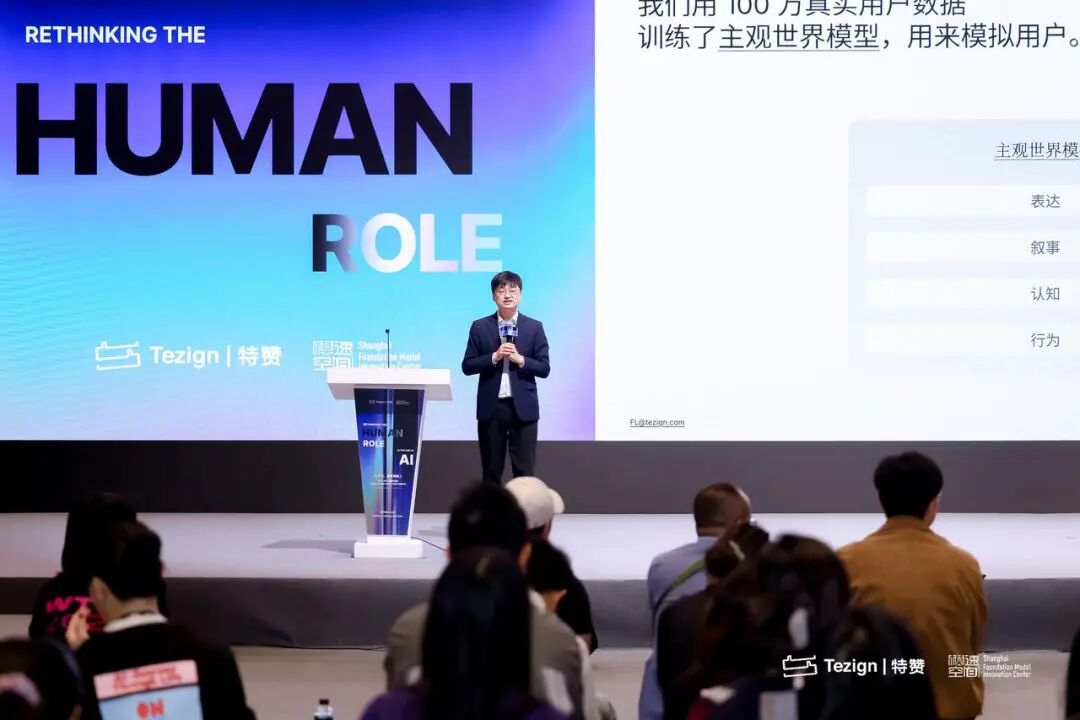
On October 22, at the first thematic forum of the 2026 West Coast International Technology Consumption Carnival (WTCC 2026) titled 'In the AI Era, Reinterpreting Humanity', Tezign Technology announced the Agentic Transformation co-construction plan and put forward a judgment: in the second half of AI + consumption, the competitive focus is shifting from 'understanding goods better' to 'understanding people better'. Supporting this judgment is Tezign's subjective world model trained on data from 1 million real users—a model that attempts to simulate consumer cognition, personality, and behavior.
Consumption is Becoming the Fastest Testing Ground for AI Implementation
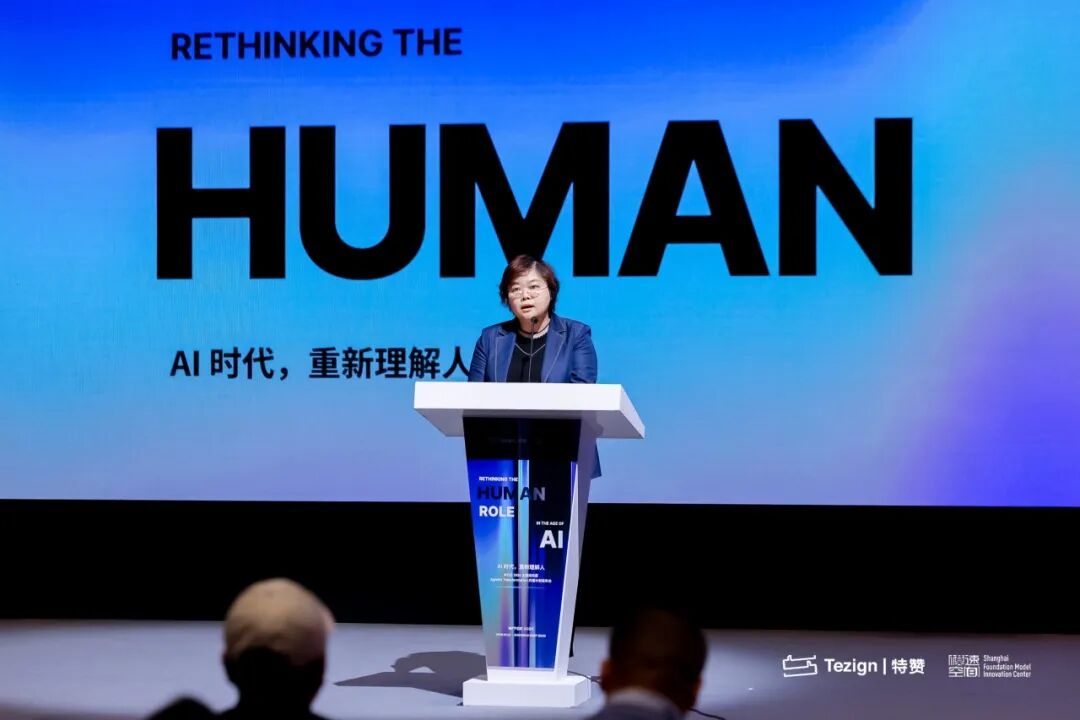
This year's WTCC is themed 'AI for a Lifetime', gathering over 400 domestic and international brands to create a global launch window for technology consumption. Wei Lan, Deputy District Mayor of Xuhui District, Shanghai, stated in her speech at the forum that generative artificial intelligence is transitioning from a period of technical breakthroughs to a deep application phase, and enterprise transformation driven by intelligent agents is becoming the core proposition of this round of commercial change; the vibrant and diverse real commercial demands are the best 'testing ground' and 'amplifier' for AI capabilities.
A somewhat counterintuitive reality is that AI has already been widely used in enterprises, but the productivity of many companies has not increased accordingly. According to Fan Ling, founder and CEO of Tezign and director of the Design AI Laboratory at Tongji University, the problem lies in the layer of 'judgment': AI is being used, but it remains at the individual level and has not entered the real business judgment of the enterprise.
'Subjective World Model': Turning Indistinct Preferences into Verifiable Objects
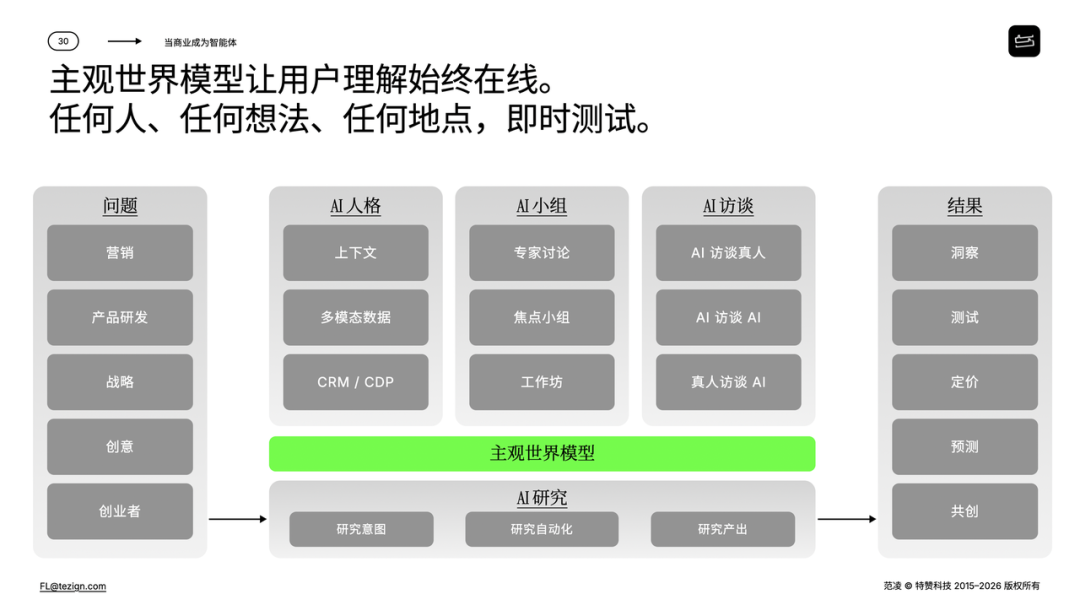
The Subjective World Model is a model trained by Tezign based on data from 1 million real users, used to simulate human cognition, personality, and behavior, answering the question: how are human preferences, motivations, and choice logic represented.
In the context of consumption, the most typical entry point is product selection. 'Who is this season's new style for?' In the past, this relied more on the experience of buyers and historical sales, but human experience is scarce and can become ineffective over time. Involving AI means first using simulated different demographics to test a product, laying out 'who would like it, who would hesitate, and why they hesitate', and then comparing it with the buyer's judgment.
In Fan Ling's view, what consumers ultimately perceive is not 'recommendations are more accurate', but 'this time, it feels like you know what I want'. More accuracy solves inventory efficiency, while better understanding me addresses whether I am willing to buy—people's true preferences are often unclear even to themselves, and the preferences expressed verbally often do not match actual choices. The value of the subjective world model lies in calibrating preferences through behavior.
It does not make decisions for enterprises but provides a verifiable object for judgment. On Atypica, Tezign allows real people and AI personas to conduct the same economic behavior experiments, and then uses the differences between the two to quantify how similar the simulations are. Previously disclosed data shows that the subjective world model achieves an accuracy rate of 85% in behavioral simulations.
Two World Models: Understanding People and Understanding Organizations
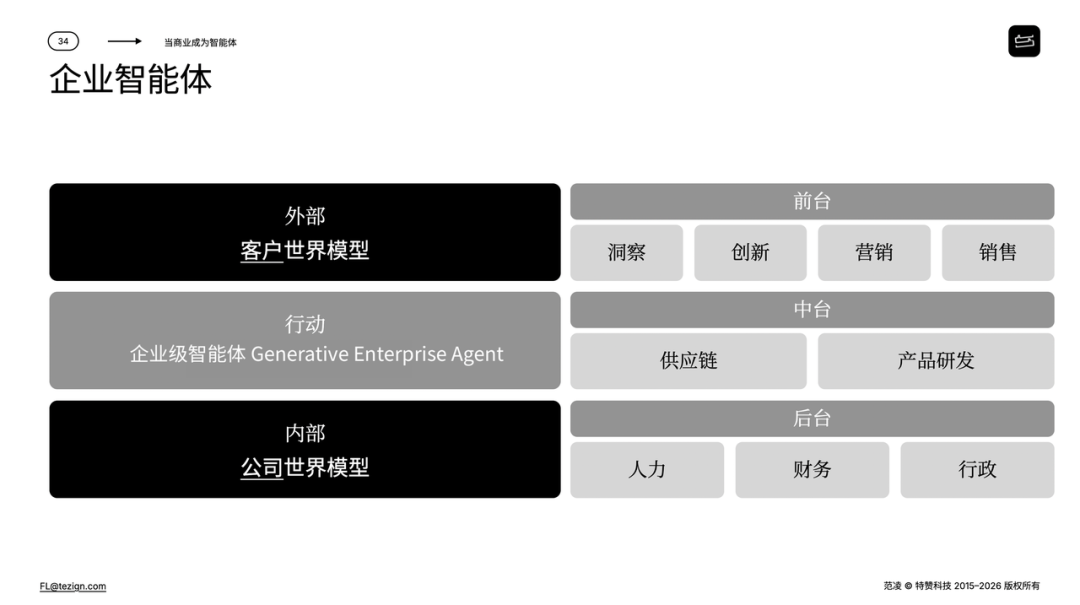
The subjective world model addresses 'external people', while another enterprise world model addresses 'internal self'—once a decision enters the enterprise, it goes through what processes, is influenced by which resources, rules, and collaborative relationships, and ultimately whether it can be truly implemented.
Both are indispensable. Fan Ling's judgment is that having only the subjective world model understands demand but cannot execute; having only the enterprise world model efficiently leads to mistakes.
Under the two models is the contextual system that enterprises need to build, which can be understood and utilized by AI—this is where Tezign's advantage lies, 'the intelligent agent does not call data, but context'. Based on these two models and context, long-term intelligent agents enter workflows, evaluations, and long-term operations, forming a closed loop of Signal·Plan·Create·Evals: answering what should be done, whether customers will accept it, and whether this can actually be done within the organization and how to advance it. Fan Ling provided a division of labor description in his speech: the intelligent agent pushes the work to 80 points, and humans then take it from 80 points to 120 points.
Fan Ling further mentioned that enterprises should not solely rely on third-party model services but should establish an autonomous and controllable intelligent capability system: models should be replaceable, data should be controllable, and judgments should be explainable, allowing intelligence to continuously add value with each real action, forming its own 'intelligent compound interest'.
However, sovereign intelligence cannot be built by a single enterprise behind closed doors: how judgments are represented, how experiences are accumulated, and how mechanisms are validated all require cross-organizational open collaboration. This is precisely the significance of Tezign initiating the Agentic Transformation co-construction plan—turning the question of 'can enterprises turn their judgments into an accumulable asset' from an internal issue of a single enterprise into an open proposition jointly promoted by multiple parties. The Agentic Transformation co-construction plan is open to universities, research institutions, enterprises, model and technology partners, and professional practitioners, focusing on understanding, judgment, action, and evolution in three directions: exploring how AI can more deeply understand real people, professional experience, and enterprise contexts; how to participate in complex judgments without standard answers; and how to continuously advance real work and improve based on action results.
On the day of the forum, the first batch of co-construction partners was announced, including Fudan University Management AI Lab, Tmall, Geek Park, Quantum Bit, 36Kr, Huxiu Think Tank, Datawhale, China Europe International Business School Artificial Intelligence and Business Innovation Research Fund, MuseOn, Atypica, and others. About 200 attendees participated offline, with online live viewership exceeding ten thousand.
If AI + consumption has an endpoint, in Tezign's judgment, what changes first may not be what consumers buy, but who is making the judgments—the transfer of judgment power from humans to systems is the most noteworthy and needs governance change in this round.
And the premise of all this is to understand 'people' well enough. 'Let business become intelligent agents.'
(Source: Interface News Alpha Says)
Category
Media & Press
Date
2026-10-22
Read Time
5 min read
Related Recommendations

Quantum Bit | Enterprises Need Two World Models for AI

Wenhui Daily | Breaking the 'Solow Paradox' in the AI Era, Tezign Technology Launches Smart Transformation Co-construction Plan